Audi Q5 Engine Problems: Oil Consumption, Timing Chain & DPF Solutions UK
September 1, 2026
Get a Quote for a Used or Reconditioned Audi Q5 Engine
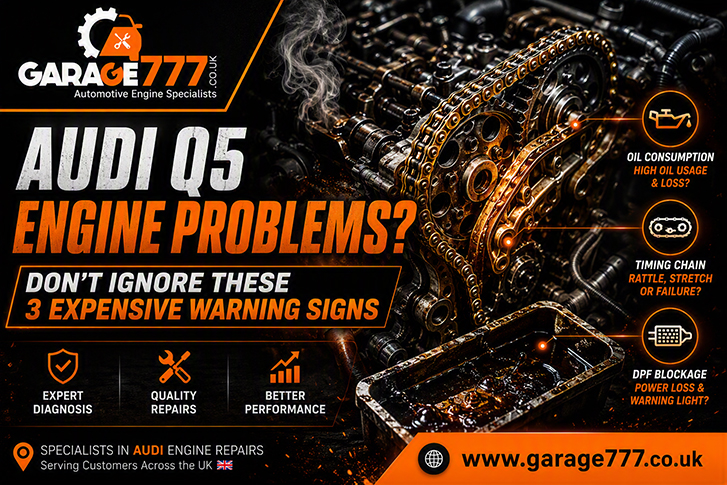
Persistent oil warnings, metal startup rattles, or sudden power loss represent immediate structural threats to your Audi Q5. Across the UK market, early-generation 2.0 TFSI petrol (EA888 Gen 2) and 2.0 TDI diesel variants suffer high rates of mechanical failure before reaching 80,000 miles. Ignoring excessive oil bypass or hydraulic tensioner slack leads directly to bent valves, scored cylinder walls, and total engine seizure—escalating repair bills beyond £4,000.
The primary cause of heavy oil burning is carbon-blocked oil control rings, while timing chain failure stems from a defective plastic tensioner latch. This Subject Matter Specialist guide provides an exact diagnostic breakdown, repair pricing, legal compliance requirements, and replacement routes for a used Audi Q5 engine, a reconditioned Audi Q5 engine, or a complete Audi Q5 engine supply and fit service across the UK.
Quick Summary: Audi Q5 Engine Reliability & Diagnostic Blueprint
- Petrol Engine Vulnerability: Gen 2 EA888 2.0 TFSI engines use thin 1.5mm piston oil control rings with narrow drain ports that clog with carbon, burning up to 1 litre of oil every 500 miles.
- Timing System Danger: Early hydraulic chain tensioners suffer from weak locking ratchet teeth that fail under fluctuating oil pressure, allowing the timing chain to jump teeth.
- Diesel Emissions Point: Short, stop-start UK commutes prevent the 2.0 TDI Diesel Particulate Filter (DPF) from reaching 600°C regeneration temperatures, causing heavy soot packing and EGR cooler blockages.
- Definitive Solution: Installing a reconditioned Audi Q5 engine built with revised 2.0mm oil scraper rings and late-revision 'K' tensioner hardware permanently resolves factory design flaws.
Deep Technical Analysis: EA888 Petrol & TDI Failure Modes
Accurate diagnosis by UK garage specialists prevents unnecessary sensor replacements and identifies whether a complete engine replacement is required.
[ Mechanical Breakdown Workflow ]
│
┌────────────────────────┴────────────────────────┐
▼ ▼
[ EA888 2.0 TFSI Petrol ] [ 2.0 TDI Diesel ]
│ │
├── Narrow Ring Ports Clog ├── Short Journeys Stop Regens
├── High Vacuum PCV Rupture ├── DPF Soot Pressure Rises
├── Tensioner Latch Snap ├── EGR Valve & Cooler Sludges
└── Chain Skips -> Valves Bend └── Limp Mode & MOT Failure
1. Piston Ring Scraper Clogging & PCV System Over-Vacuum
The second-generation EA888 petrol engine relies on thin 1.5mm oil control rings with small oil return holes. High operating temperatures cause engine oil to carbonise inside these miniature oil passages. As a result, the rings lock inside the piston lands, losing wall contact and allowing oil to sweep directly into the combustion chamber on every stroke. Simultaneously, the internal rubber diaphragm of the Positive Crankcase Ventilation (PCV) valve splits under vacuum, pulling oil vapour straight into the intake manifold and contaminating spark plugs and intake valves.
2. Hydraulic Timing Tensioner Ratchet Failure
Unlike timing belts that follow standard replacement schedules, EA888 engines use a timing chain driven by a hydraulic tensioner. Early tensioner designs featured weak plastic locking teeth intended to maintain chain tension during engine shutdown. Over time, thermal cycling degrades this plastic clip. Upon cold engine startup—before full hydraulic oil pressure builds—the chain skips teeth on the camshaft sprockets, desynchronising engine timing and driving intake valves directly into rising pistons.
3. Diesel Particulate Filter (DPF) & EGR System Restriction
The 2.0 TDI diesel engine depends on high exhaust temperatures during passive regeneration to convert accumulated soot into fine ash. Driving primarily on low-speed UK town roads stops exhaust gases from reaching the required 600°C threshold. Unburnt soot packs the DPF matrix, creating high exhaust backpressure. This backpressure forces carbon deposits into the Exhaust Gas Recirculation (EGR) cooler, causing sticky EGR valves, turbocharger vane binding, and immediate vehicle limp mode.
Audi Q5 Technical Engine Specification Matrix
This table maps original factory engine codes, production years, oil capacities, and mechanical risk profiles across the Audi Q5 range:
| Engine Code | Displacement & Fuel | Production Range | Oil Specification | Primary Mechanical Risk Profile |
|---|---|---|---|---|
| CDNC / CAEB | 2.0 TFSI Petrol | 2.008 – 2.012 | 4.6L (5W-30 VW 504.00) | Piston ring carbon locking & tensioner latch snap |
| CPMB / CAED | 2.0 TFSI Flex/Petrol | 2.013 – 2.017 | 4.6L (5W-30 VW 504.00) | Camshaft spool valve wear & timing chain elongation |
| CAGB / CAHA | 2.0 TDI Diesel | 2.008 – 2.012 | 5.0L (5W-30 VW 507.00) | DPF soot packing & oil pump hex shaft rounding |
| CNHA / CSUB | 2.0 TDI Clean Diesel | 2.013 – 2.017 | 4.7L (5W-30 VW 507.00) | AdBlue heater element failure & EGR cooler restriction |
Diagnostic Checklist: Identifying Early Warning Signs
Detecting issues early helps avoid total engine seizure and keeps repair options manageable:
- Startup Metallic Rattle: A loud slapping noise lasting 2 to 5 seconds behind the front timing cover during cold starts signals timing chain tensioner collapse.
- Persistent Blue Exhaust Smoke: Blue smoke under hard acceleration confirms oil leaking past locked piston rings directly into the combustion chamber.
- Fault Code P0016: Camshaft/Crankshaft Position Correlation error codes confirm severe timing chain elongation beyond ECU adjustment limits.
- DPF Warning Light & Fan Overrun: An illuminated DPF light paired with continuous cooling fan operation after short drives indicates interrupted active regeneration.
- Irregular Oil Level Drops: Needing to add 1 litre of engine oil every 500 to 800 miles without visible exterior leaks signals internal oil bypass.
Replacement Strategy: Used vs Reconditioned Engines
When total engine failure occurs, evaluating cost against vehicle longevity determines the best replacement option.
[ Replacement Option Comparison ]
│
┌──────────────────────────┴──────────────────────────┐
▼ ▼
[ Reconditioned Engine Option ] [ Used Engine Option ]
│ │
├── Bare Block Hydro-Cleaned ├── Sourced from Donor Vehicle
├── Upgraded 2.0mm Pistons Fitted ├── Checked for Compression
├── Revision 'K' Tensioner Kit ├── Original Factory Spec
└── 12 to 24 Month Full Warranty └── 30 to 90 Day Limited Warranty
1. Reconditioned Audi Q5 Engine
A reconditioned Audi Q5 engine provides the absolute best long-term reliability. The engine block is completely stripped, chemically cleaned, and pressure-tested for hairline cracks. Reconditioners discard the flawed factory pistons and install upgraded pistons with wider oil return channels and 2.0mm scraper rings. The unit receives new main bearings, updated timing chains, modern tensioners, and fresh valve stem seals. This completely eliminates original design defects and includes a 12-to-24-month unlimited mileage warranty.
2. Used Audi Q5 Engine
A used Audi Q5 engine is a complete assembly taken from a low-mileage donor vehicle or write-off. Selecting a used Audi Q5 engine lowers immediate repair expenses by 35% to 50%. However, fitting a used engine without replacing the timing chain tensioner or inspecting the piston ring history risks inheriting the same oil burning issues. It is best suited for older vehicles where repair costs must be kept strictly within market value.
3. Audi Q5 Engine Supply and Fit Services
Choosing a complete Audi Q5 engine supply and fit package routes vehicle recovery, engine procurement, physical installation, ECU software adaptation, and fluid flushes through a single specialist garage. Managing the entire repair process under one roof ensures a unified warranty that covers both component parts and workshop labor, eliminating cross-claim disputes between separate parts suppliers and fitting garages.
UK Market Financial Breakdown: Repair & Replacement Costs
This breakdown details average UK market costs for engine replacement options, including components, workshop labor, and complete fitting packages:
| Service Option | Parts Cost | Labor Cost (Average) | Total Estimated Cost | Warranty Coverage |
|---|---|---|---|---|
| Reconditioned Audi Q5 Engine | £2,200 – £3,200 | £800 – £1,200 | £3,000 – £4,400 | 12 – 24 Months |
| Used Audi Q5 Engine | £1,200 – £1,800 | £800 – £1,100 | £2,000 – £2,900 | 30 – 90 Days |
| In-Garage Cylinder Head Rebuild | £1,500 – £2,200 | £1,100 – £1,600 | £2,600 – £3,800 | 6 – 12 Months |
| Preventative Timing Chain Replacement | £350 – £550 | £450 – £650 | £800 – £1,200 | 12 Months |
UK Legal Framework: DVLA Updates & MOT Compliance
Installing a replacement engine requires following UK legal and road safety standards to protect vehicle valuation, insurance validity, and MOT status:
- DVLA V5C Document Updates: If you fit an engine with the exact same engine displacement and fuel type, notify the DVLA of the new engine serial number using Section 7 of your V5C logbook. If fitting a different engine capacity, you must supply an official garage receipt or an inspection report on company letterhead.
- MOT Emissions Compliance (Diesel DPF): Removing or modifying a DPF filter is illegal under UK road regulations. Visual checks during the annual MOT test will automatically fail any vehicle with an absent, modified, or gutted DPF casing.
- Insurance Provider Policy Updates: You must inform your motor insurer of an engine replacement. Failing to record updated engine serial numbers or specification changes can void your coverage during a claim.
Preventative Technical Protocols for Extended Engine Life
Following these specialized maintenance procedures protects your replacement engine from premature component failure and repeat factory faults:
- Shortened Oil Change Intervals: Reduce long-life service schedules down to 5,000–6,000 miles. Always use VW 504.00/507.00 approved fully synthetic oil to keep carbon from locking the piston rings.
- PCV Valve Replacement: Replace the PCV assembly on TFSI engines every 40,000 miles to prevent high crankcase vacuum from damaging the rear main oil seal.
- Walnut Shell Valve Cleaning: Direct injection engines accumulate heavy carbon on intake valves every 40,000 to 45,000 miles. Performing media blasting restores original airflow, throttle response, and engine efficiency.
- Weekly Highway Regeneration Runs: Take diesel models on a weekly 30-minute motorway run above 2,500 RPM. This creates the exhaust heat required to clear accumulated soot from the DPF filter.
Frequently Asked Questions
How much does an Audi Q5 engine replacement cost in the UK?
A complete engine swap ranges from £2,000 to £4,400. Sourcing a used Audi Q5 engine with labor costs around £2,000 to £2,900, while a fully warranted reconditioned Audi Q5 engine installed via a complete Audi Q5 engine supply and fit package ranges from £3,000 to £4,400.
What causes severe oil consumption in the Audi Q5 2.0 TFSI?
The main cause is narrow 1.5mm factory oil scraper rings on EA888 Gen 2 pistons. Soot blocks the tiny drain holes, locking the rings in place and forcing oil into the combustion chamber to burn alongside fuel.
Will a timing chain failure destroy my Audi Q5 engine?
Yes. The EA888 is an interference engine. If the timing chain slips or snaps, the valves collide directly with the rising pistons, bending valve stems and destroying the cylinder head.
Is it safe to install a used engine in an Audi Q5?
Yes, provided you verify donor vehicle mileage, complete a compression test, and fit an updated OEM timing chain tensioner prior to installation.
Do I need to inform the DVLA after an engine replacement?
Yes. You must update Section 7 of your V5C logbook with the new engine serial number to keep your vehicle records legally compliant for insurance and resale.
How often should oil be changed on an EA888 engine to prevent failure?
Change engine oil and filters every 5,000 to 7,000 miles using VW 504.00 certified synthetic oil to maintain hydraulic pressure and extend timing component life.
Request Your Dependable Engine Replacement Quote Today
Stop risking sudden catastrophic engine failure or spending hundreds on extra oil top-ups. Whether you need a tested used Audi Q5 engine, a factory-corrected reconditioned Audi Q5 engine, or an all-inclusive Audi Q5 engine supply and fit package with complete warranty backing, our UK network of engine specialists is ready to help.
Get Your Free Engine Quote Now: Enter your vehicle registration number and postcode below to receive instant, direct quotes from verified UK engine rebuild specialists. Restore your Audi Q5 to peak condition today!
Written by Jennifer James | Dedicated ET Automotive Writer & MechanicCategories
- Audi Engines
- Range Rover Engines
- Volkswagen Engines
- Ford Engines
- BMW Engines
- Subaru Engines
- Honda Engines
- hybrid Engines
- Euro NCAP
- Off-Road Engines
- MINI Engines
- Mitsubishi Engines
- saloon Engines
- Jaguar Engines
- Van Engines
- Land Rover Engines
- Mercedes-Benz Engines
- Nissan Qashqai Engines
- Peugeot Engines
- Skoda Engines
- Vauxhall Engines
- Automatic Transmission
- Alfa Romeo Engines
- Fuel Economy Engines
- Citroen Engines
- Iveco Engines
- SUV Engines
- diesel engines
- Mazda Engines
- cars Engines
- Renault Engines
- engines
- Toyota Engines
- Nissan Engines
- KIA Engines
- Diesel Engine
- Hyundai Engines
- Infographic
- Petrol Engine
- Engine
- UK Engines
- Suzuki Engines
- Daihatsu Engines
- General Engines
- Hatchback
- new technology
- Insurance
- Fiat Engines