BMW B58 Engine Failure? Know Your Options and Real UK Costs Before You Pay
November 13, 2026
BMW B58 Replacement Cost UK: Used vs Reconditioned Prices
The BMW B58 engine is one of BMW's best modern engines — genuinely long-lived, but not immortal, and not cheap to replace if it's neglected.
- Expected lifespan: 150,000–200,000+ miles with proper maintenance
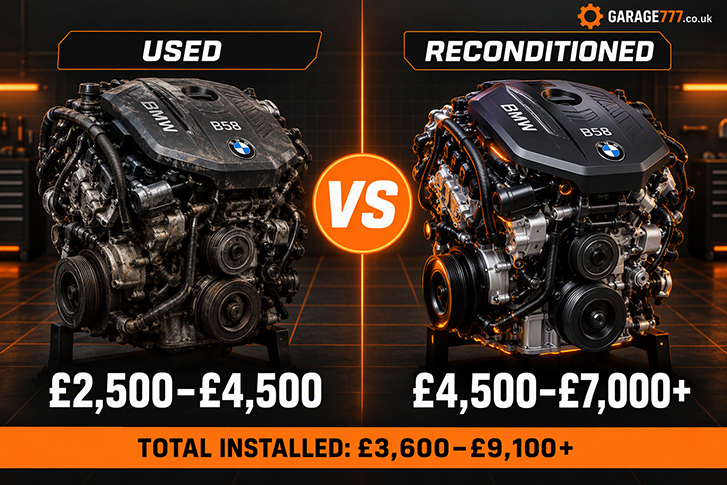
- Used engine: £2,500–£4,500 (engine only)
- Reconditioned: £4,500–£7,000+
- Labour/fitting: £800–£1,500 · Ancillaries/fluids: £300–£600
- Total installed: £3,600–£9,100+
- Best value move: buy a stamped service history, and compare quotes on identical scope
Compare BMW B58 engine replacement prices across the UK before committing — the spread on a B58 job is several thousand pounds.
How long does a BMW B58 last? Real UK mileage data (150,000–200,000+ miles), the faults that shorten it, and 2026 replacement costs from £3,600 to £9,100+.
Introduced in 2015, the B58 engine is a 3.0-litre turbocharged inline-six petrol engine that replaced the N55. It was engineered with efficiency, emissions and durability in mind, and three design choices matter most:
- A closed-deck block, which stiffens the structure
- An integrated exhaust manifold
- A significantly improved cooling system
Together these make the BMW B58 engine markedly more durable than its predecessor. Variants include the B58B30M0, B58B30M1 and B58B30O0, with outputs from around 320 bhp to over 380 bhp. You'll find it in the BMW 340i and M340i, the X3 M40i, the Toyota Supra (as the B58B30C), and more.
BMW B58 Engine Lifespan and What Replacement Really Costs
Design supports high mileage; maintenance decides whether you get there.
| Mileage | What to expect |
| 0–80,000 | Generally trouble-free with routine servicing; minor external seepage may begin |
| 80,000–120,000 | The preventative window — coolant components and gaskets often need attention |
| 120,000–200,000+ | Core internals stay resilient with proactive care; many UK cars pass 150,000 |
The catch is in the middle band. Ignore the coolant and gasket work at 80,000–120,000 miles and you invite the failures that cut BMW B58 engine life short. These are the common BMW B58 problems to watch for.
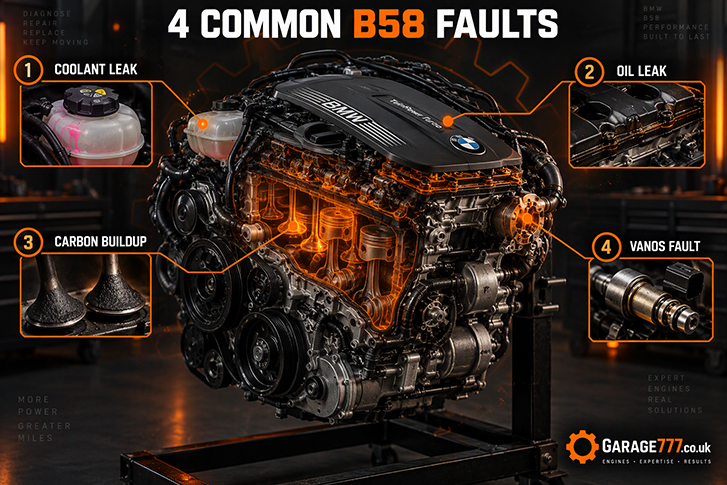
1. Coolant leaks. The plastic expansion tank and hoses develop micro-cracks with heat cycling, and a failing water pump can dump coolant suddenly. Ignored, this leads to overheating and serious internal damage.
2. Oil leaks. The valve cover gasket and oil filter housing gasket degrade with age. What starts as a burning smell can progress to low oil pressure — a primary cause of premature wear.
3. Carbon buildup. Direct injection means fuel no longer washes the intake valves, so carbon accumulates. Severe buildup causes rough idling, misfires and lost performance; walnut blasting is the standard cure.
4. VANOS solenoids. These can clog or fail electrically, triggering a check-engine light and a noticeable loss of low-end torque. Usually an inexpensive, straightforward repair.
The short version
| Item | Indicative cost |
| Used B58 (low mileage), engine only | £2,500–£4,500 |
| Reconditioned B58, engine only | £4,500–£7,000+ |
| Labour and fitting | £800–£1,500 |
| Ancillaries and fluids | £300–£600 |
| Total installed | £3,600–£9,100+ |
Cheapest BMW B58 engine deals sit in the used BMW engine column — and that's precisely where the risk lives unless the donor history is verifiable.
Why the B58 lasts so well for your BMW B58
| Feature | Used | Reconditioned |
| Condition | As removed; unknown internal wear | Stripped, cleaned, rebuilt with new wear parts |
| Price | £2,500–£4,500 | £4,500–£7,000+ |
| Warranty | 30–90 days (varies) | 12–24 months, parts and labour |
| Risk | Moderate to high | Low |
If you're keeping the car, a reconditioned BMW B58 engine usually pays for itself — the extra cost buys known internals and real cover.
Real-world lifespan, by mileage for your BMW B58
- Prioritise a stamped service history over a low mileage claim.
- Avoid cars with 15,000-mile oil intervals — long intervals are the B58's enemy.
- Address coolant and oil leaks early — they're cheap fixes that prevent expensive ones.
- Compare on identical scope, including ancillaries and warranty.
- Do the water pump and thermostat while the engine is out.
The four faults that shorten a B58 for your BMW B58
A dropping coolant level, a burning oil smell, a rough idle or a check-engine light are all early signals on a B58. Diagnosed promptly, they're manageable. Left, they become the reason a £200 repair turns into a £7,000 engine bill.
And one reassurance worth knowing: the B58's timing chain sits at the rear of the engine and is highly durable — chain failure is exceptionally rare, unlike BMW's older N47 diesel.
What a Replacement Costs in 2026 for your BMW B58
Two B58s leave the factory identical. Ten years later, one is at 190,000 miles and still pulling cleanly; the other is being quoted for a replacement. The difference is almost always maintenance, and it's the key to extending BMW B58 engine life.
Oil discipline is the biggest lever. The B58 does not tolerate long intervals well, and the warning in the data is explicit: avoid cars with 15,000-mile oil changes. Regular, correct-spec oil keeps the internals — pistons, bearings, the turbo — in good order, and that's what the 150,000–200,000 mile figures depend on.
Cooling care is the second. The expansion tank and hoses crack with heat cycling, and a water pump can fail without much warning. A dropping coolant level is cheap to investigate and catastrophic to ignore. Overheating is the fastest way to turn a durable engine into a replacement job.
Early gasket attention is the third. A valve cover or oil filter housing leak starts as a smell and ends, if ignored, as low oil pressure and premature wear.
Fix those three and the B58 behaves like the engine its reputation suggests.
Used vs reconditioned BMW B58: the honest comparison
Most adverts for a used BMW B58 engine say, "low mileage, fully serviced". On this engine, that claim needs evidence: a stamped service history, invoices, and a mileage trail. What matters isn't the number on the clock but how the car was treated between services. Ask for records; if they don't exist, treat the engine as unknown.
How to avoid overpaying on BMW B58
Get a diagnosis in writing first. Several B58 problems — coolant leaks, VANOS solenoids, carbon buildup — are repairable at a fraction of engine cost. If the diagnosis genuinely points to BMW B58 engine failure, compare used and reconditioned BMW engine quotes on identical scope, with ancillaries and warranty stated. That's how you turn a stressful situation into a calculated one.
Don't ignore the warning signs for your BMW B58
The B58 isn't a single engine — it's a family. The B58B30M0, B58B30M1 and B58B30O0 cover different applications and outputs, from around 320 bhp to over 380 bhp, and the B58B30C variant powers the Toyota Supra. They appear in the BMW 340i and M340i, the X3 M40i, and others.
Two practical consequences follow. First, the correct replacement must match your vehicle's variant — a unit from a different application isn't automatically right. Second, availability and price vary by variant, so a quote for "a B58" is only meaningful once the exact code is confirmed. That's why we ask for your registration and model before comparing BMW B58 engine replacement quotes.
Why some B58s last and others don't for your BMW B58
Three mistakes cost B58 owners the most. Buying on a low mileage claim without service records. Ignoring a coolant level that keeps dropping. And choosing a used unit with a 60-day warranty to save money on a car worth £25,000 or more. Each is understandable, and each is expensive.
Reading a used B58 advert for your BMW B58
Good value on a BMW B58 engine replacement isn't the cheapest quote — it's a fair price for an engine whose peripherals have been addressed, fitted with ancillaries renewed, and backed by a warranty worth using. On a car you're keeping, that combination is the one that avoids a second bill. Compare on those terms and the value is obvious.
What to do if your B58 has failed for your BMW B58
The B58 is the engine that made a lot of people trust modern BMWs again. A closed-deck block, an integrated exhaust manifold and proper cooling give it the potential for 150,000–200,000 miles, and its faults — a plastic expansion tank, a gasket, some intake carbon, an occasional solenoid — are all fixable. That combination makes it an excellent used buy and an excellent rebuild candidate.
Where owners run into trouble is neglect: long oil intervals, ignored coolant loss, and delayed gasket repairs. Avoid those, and the B58 does what the engineering promised. It's that simple, and on a car worth tens of thousands, it's worth stating plainly.
The variants, and why they matter for pricing for your BMW B58
How many miles can a B58 last?
150,000–200,000 miles with strict maintenance, particularly regular oil changes.
What are the common B58 problems?
Coolant leaks (expansion tank/water pump), oil leaks (valve cover/oil filter housing gaskets), and carbon buildup on the intake valves.
How much is a B58 replacement?
£3,600–£9,100+ fully installed, depending on used or reconditioned and the ancillary work.
Does the B58 have timing chain problems?
No — unlike BMW's N47 diesel, the B58's rear-mounted chain is highly durable.
Should I compare quotes?
Always. Compare replacement engine prices across vetted UK suppliers, with warranty and ancillary detail included.
Where the pitfalls are for your BMW B58
Enter your registration and mileage to compare reconditioned and used BMW B58 engine quotes from vetted UK suppliers, with warranty detail attached.
Compare prices & get free quotes →
Written by Jennifer James | Dedicated ET Automotive Writer & MechanicCategories
- Audi Engines
- Range Rover Engines
- Volkswagen Engines
- Ford Engines
- BMW Engines
- Subaru Engines
- Honda Engines
- hybrid Engines
- Euro NCAP
- Off-Road Engines
- MINI Engines
- Mitsubishi Engines
- saloon Engines
- Jaguar Engines
- Van Engines
- Land Rover Engines
- Mercedes-Benz Engines
- Nissan Qashqai Engines
- Peugeot Engines
- Skoda Engines
- Vauxhall Engines
- Automatic Transmission
- Alfa Romeo Engines
- Fuel Economy Engines
- Citroen Engines
- Iveco Engines
- SUV Engines
- diesel engines
- Mazda Engines
- cars Engines
- Renault Engines
- engines
- Toyota Engines
- Nissan Engines
- KIA Engines
- Diesel Engine
- Hyundai Engines
- Infographic
- Petrol Engine
- Engine
- UK Engines
- Suzuki Engines
- Daihatsu Engines
- General Engines
- Hatchback
- new technology
- Insurance
- Fiat Engines