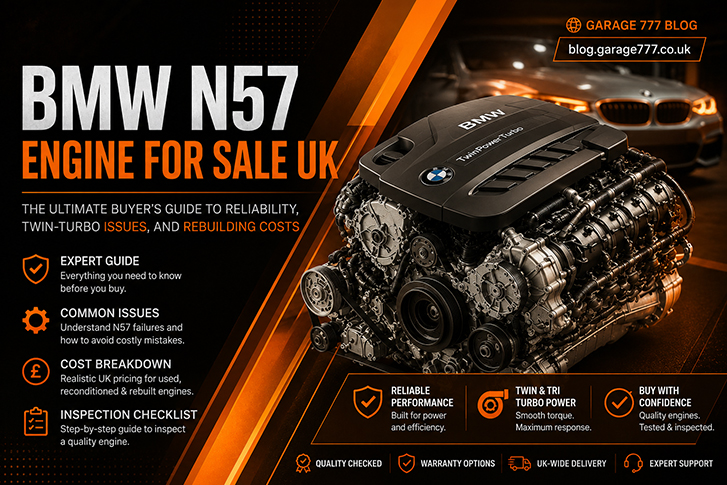
BMW N57 Engine for Sale UK: The Ultimate Buyer’s Guide to Reliability, Twin-Turbo Issues, and Rebuilding Costs
July 16, 2026
How To Source and Inspect a Premium BMW N57 Six-Cylinder Diesel Engine in the Uk
Executive Summary
The BMW N57 is a highly celebrated 3.0-litre straight-six common-rail diesel engine produced by BMW between 2008 and 2019. Serving as the powerhouse for premium UK cruisers like the BMW 330d/335d (F30), BMW 530d/535d (F10), and the heavy-duty BMW X5 xDrive30d/40d (F15), the N57 powerplant is universally revered for its effortless torque, silk-smooth inline-six balance, and surprising fuel efficiency.
However, beneath its legendary performance credentials lies a complex architecture prone to severe, high-mileage mechanical failures. Most notably, the N57 engine is susceptible to crankshaft main bearing seizure (rod knock), timing chain wear, and high-pressure fuel pump (HPFP) internal failure (often referred to as "shrapnel contamination").
If you are currently scanning the UK market for a used BMW X5 engine for sale or a precision-engineered reconditioned N57 engine, this guide provides the exact technical blueprint, inspection steps, and realistic replacement cost calculations you need to secure a bulletproof unit.
- Key Verdict: The BMW N57 is one of the greatest performance diesel engines ever built, but it demands meticulous maintenance. Purchasing a used unit with undocumented service history is an incredibly high financial risk due to the possibility of sudden bottom-end failure.
- Critical Caveats: Every prospective N57 engine must be subjected to an oil pan inspection for metallic copper/gold bearing flakes and a timing chain slack check prior to installation.
Understanding the BMW N57 Engine Architecture
The BMW N57 succeeded the older M57 engine family. While the M57 was famous for its cast-iron block durability, the N57 moved to a modern, lightweight aluminium-alloy closed-deck engine block with cast-iron cylinder liners. This transition saved significant weight over the front axle, drastically improving vehicle handling dynamics.
Valvetrain and Rear-Mounted Timing Chain
To comply with strict European pedestrian safety regulations, BMW moved the timing chain assembly to the rear of the engine block (the flywheel side). This allowed the front of the engine to sit lower, creating a larger crumple zone under the bonnet. However, this design choice means that any maintenance on the timing chains, tensioners, or guides requires completely removing the engine or separating the transmission.
Fuel Injection & Multi-Stage Turbocharging
The N57 engine operates on a highly pressurized common-rail system utilizing piezoelectric injectors running at pressures ranging from 1,800 bar to a massive 2,000 bar on high-output variants. The air induction system varies significantly depending on the power tier:
- Single-Turbo (N57D30A): Features a single variable geometry turbocharger (VGT).
- Twin-Turbo (N57D30B): Features a sequential twin-turbocharger setup (one small high-pressure, one large low-pressure turbo).
- Tri-Turbo (N57D30C): A masterpiece of engineering featured in the M50d models, utilizing three turbochargers to deliver immediate throttle response across the entire rev band.
N57 Engine Variants & Power Outputs Explained
To source the correct replacement BMW engine, you must identify the exact code matching your vehicle's ECU and wiring loom configuration.
+------------------+-----------------+-------------------+-----------------------------------------+
| Engine Code | Power Output | Torque Output | Primary UK Vehicle Applications |
+------------------+-----------------+-------------------+-----------------------------------------+
| N57D30A (Single) | 204 hp to 258 hp| 450 Nm to 560 Nm | BMW 330d, 530d, 730d, X3 30d, X5 30d |
+------------------+-----------------+-------------------+-----------------------------------------+
| N57D30B (Twin) | 299 hp to 313 hp| 600 Nm to 630 Nm | BMW 335d, 535d, 640d, 740d, X5 40d |
+------------------+-----------------+-------------------+-----------------------------------------+
| N57D30C (Triple) | 381 hp | 740 Nm | BMW M550d, X5 M50d, X6 M50d |
+------------------+-----------------+-------------------+-----------------------------------------+
1. N57D30A (Single-Turbo)
The most common variant on UK roads, found in the immensely popular BMW 330d and BMW 530d. It offers a perfect blend of fuel economy (often achieving 45+ MPG on motorways) and robust performance. It utilizes standard piezoelectric injectors and is highly reliable if serviced regularly.
2. N57D30B (Twin-Turbo)
Powering performance heavyweights like the BMW 335d xDrive and BMW 640d, this variant utilizes sequential turbocharging to eliminate turbo lag completely. It features highly sensitive charge-air cooling ducting and higher-spec fuel system components that run at elevated temperatures.
3. N57D30C (Tri-Turbo / Quad-Turbo later)
This is a highly specialized high-performance engine found in the prestigious M50d range. The engine bay is incredibly cramped, and the complex vacuum system controlling the three turbochargers requires highly specialized knowledge to maintain and diagnose.
Critical Failure Modes: What Breaks on an N57 Engine?
While the N57 is physically strong, it possesses several specific engineered failure points that can lead to catastrophic damage if left unchecked.
1. Crankshaft Main Bearing / Rod Bearing Seizure (Rod Knock)
The most critical and devastating issue affecting the N57 engine is spun rod or main bearings.
- The Cause: BMW utilized lead-free, eco-friendly bearing shells in the N57. Over time, particularly when subjected to long oil change intervals (15,000+ miles), the oil loses its viscosity and suffers from fuel dilution. The thin layer of oil protecting the crankshaft bearings breaks down, leading to metal-on-metal contact. The bearing shells overheat, deform, spin out of their seats, and weld themselves to the crankshaft.
- The Result: A locked engine or a thrown connecting rod through the side of the engine block.
- Symptoms:
- A soft, deep rhythmic metallic knocking noise from the bottom-end of the engine, especially audible when the engine is warm at around 1,500 - 2,000 RPM.
- A sudden drop in oil pressure warnings on the dashboard.
- Fine, gold or copper metallic glitter present in the oil filter housing.
2. Timing Chain Wear and Snapping
Although the N57 is less prone to timing chain snapping than the smaller N47, it still suffers from timing chain stretch—particularly on engines that have covered over 100,000 miles or those with poor service history.
- The Cause: The hydraulic chain tensioners rely entirely on engine oil pressure. If oil changes are neglected, carbon sludge restricts oil flow to the tensioner, preventing it from keeping the chain taut. The chain then slaps against the plastic guide rails, shattering them and eventually jumping teeth or snapping.
- Symptoms:
- A distinct metallic rattling, sweeping, or "shuffling" noise from the rear of the engine block during cold starts.
- Uneven idling and camshaft correlation fault codes on a diagnostic scanner.
3. High-Pressure Fuel Pump (HPFP) CP4 Failure
The N57 utilizes the Bosch CP4 high-pressure fuel pump. This pump relies entirely on diesel fuel for its internal lubrication.
- The Cause: If the vehicle is misfueled (petrol introduced into the tank) or if low-quality, dry diesel is used, the internal roller of the CP4 pump can turn 90 degrees out of alignment. It then grinds against the drive shaft, creating microscopic metal shrapnel.
- The Result: This metallic shrapnel is sent throughout the entire fuel system, instantly ruining all six expensive piezoelectric injectors, the fuel rails, lines, and the fuel tank.
- Symptoms:
- The engine suddenly cuts out while driving and refuses to restart.
- Low fuel rail pressure fault codes.
- Shiny, silver metallic powder inside the fuel metering valve on top of the HPFP.
4. Intake Manifold Swirl Flap Defect & Carbon Blocking
Much like the B47, the N57's EGR valve redirects carbon soot back into the intake. When mixed with oil vapor from the crankcase ventilation, it creates a thick sludge.
- The Danger: The plastic swirl flaps can become so heavily encrusted that the physical linkage snaps. In early N57 models, the actual metal screws holding the flaps could loosen and get sucked into the combustion chamber, resulting in instant cylinder wall and piston destruction.
- Symptoms: Low-end flat spots, rough idling, and active DPF clogging codes due to incomplete combustion.
The N57 Pre-Purchase Inspection Checklist
Before buying a used N57 engine from a UK scrap yard or an online engine supplier, execute this comprehensive inspection protocol:
Step 1: Inspect the Oil Filter for Metallic Glitter
This is your absolute best defense against buying an engine with failing rod bearings.
- Unscrew the plastic oil filter cap.
- Remove the paper filter element and carefully pry open the pleats.
- Shine a bright smartphone light or LED torch into the pleats.
- If you see copper, gold, or brass-colored flakes, the main bearings are actively disintegrating. Do not buy this engine under any circumstances.
Step 2: Check for Timing Chain Play
- With the oil cap removed, use a long, curved pick tool to reach the timing chain visible inside the housing.
- Attempt to wiggle the chain. If there is noticeable slack or if you can lift the chain off the cam sprocket teeth, the hydraulic tensioner is worn, or the chain has stretched. Budget for a full replacement before fitting.
Step 3: Execute a Crankshaft Endplay Test
- Using a pry bar, gently try to push the front crankshaft pulley (harmonic balancer) forward and backward.
- If there is visible lateral play (thrust movement), the crankshaft thrust bearings are worn out. This is highly common on manual cars where the clutch pressure plate puts constant lateral load on the crankshaft.
Step 4: Analyze the Glow Plug Holes / Compression
- Remove the glow plugs and inspect their tips. If the tip of a glow plug is melted, it indicates a failing fuel injector that has been "dripping" fuel, which causes localized hot spots and can melt the piston crown.
- Run a mechanical compression test. Healthy cylinders should display pressure between 340 PSI and 420 PSI with nominal variation.
Cost Analysis: Used vs. Reconditioned vs. Remanufactured N57 Engines
Because the N57 is a premium six-cylinder engine, replacement costs are considerably higher than those for four-cylinder models.
+-----------------------------------+--------------------+------------------------+---------------------+-------------------------+
| Engine Option | Purchase Cost (UK) | Essential Setup Costs | Warranty Period | Total Installed Cost |
+-----------------------------------+--------------------+------------------------+---------------------+-------------------------+
| Used N57 (Breaker Yard) | £2,200 - £3,500 | £1,200 - £1,800 | 30 to 90 Days | £3,800 - £5,800 |
+-----------------------------------+--------------------+------------------------+---------------------+-------------------------+
| Reconditioned N57 (Specialist) | £4,500 - £6,500 | Included in unit | 12 to 24 Months | £6,200 - £8,500 |
+-----------------------------------+--------------------+------------------------+---------------------+-------------------------+
| Remanufactured (OEM BMW) | £9,000 - £12,500 | Included in unit | 24 Months | £11,000 - £15,000 |
+-----------------------------------+--------------------+------------------------+---------------------+-------------------------+
Understanding the Hidden Costs of a Used N57 Engine Swap
Buying a used N57 engine for £2,500 from a donor vehicle is only the starting point. To guarantee it doesn't fail 5,000 miles later, you must replace high-risk wear items while the engine is out of the chassis.
The "While-You-Are-In-There" N57 Parts List:
- Complete Timing Chain & Guide Kit: Highly recommended for any N57 over 80,000 miles. Cost: £350 - £500 (Parts only).
- Upgraded Oil Pump: The N57 oil pump wear contributes heavily to bearing starvation. Replacing it with a brand-new OEM Pierburg pump is highly advised. Cost: £250 - £350.
- New Crankshaft Bearings (Preventative): Many specialist garages refuse to install a used N57 unless they are allowed to pull the oil sump and fit fresh King Racing or OEM main and rod bearings. Cost: £300 - £450.
- Harmonic Balancer (Crankshaft Pulley): The rubber damper inside the main crankshaft pulley degrades over time, splitting and causing catastrophic belt loss. Cost: £180 - £300.
- Labor Fees: Replacing a six-cylinder longitudinal engine in an xDrive (all-wheel-drive) BMW is highly labor-intensive, requiring the subframe to be dropped. Expect 14 to 20 hours of labor. Average cost: £1,200 - £2,000.
The Anatomy of a Properly Reconditioned N57 Engine
If you choose the reconditioned route, you must ensure the builder is performing a comprehensive engineering overhaul, rather than just cleaning the outside and replacing gaskets. A professional N57 rebuild must include:
1. Crankshaft Line Boring and Balancing
If the donor block suffered a spun bearing, the heat generated can warp the main bearing journals. The block must be line-bored to restore perfect alignment. The crankshaft itself must be dynamically balanced and micro-polished, or replaced entirely if the scoring exceeds 0.25mm.
2. Upgraded Sputter Bearings
A premier reconditioning BMW X5 engine specialist will replace the weak factory bearings with high-durability Sputter bearings (often derived from heavy-duty industrial or racing applications). These bearings are coated with a highly wear-resistant layer via physical vapor deposition, allowing them to withstand temporary oil pressure drops without scoring.
3. Valve Seat Cutting and Pressure Testing
The cylinder head must be vacuum-tested to ensure the intake and exhaust valves seal perfectly. If there is any leakage, the valve seats are cut and the valves are lapped in by hand. Brand-new valve stem seals are installed to prevent oil from seeping down into the combustion chambers overnight.
N57 Chassis Compatibility & Swap Guide
The N57 is a versatile engine, but casting designs and oil pans differ vastly between rear-wheel-drive (RWD) and all-wheel-drive (xDrive) variants.
CRITICAL COMPATIBILITY NOTE: The oil sump on an xDrive (AWD) vehicle has a physical tunnel cast directly through it to allow the front passenger-side driveshaft to pass through. If you buy an engine from an RWD car to fit an xDrive car, you must swap over the oil pump pickup tube and the oil pan. Additionally, ensure the block casting has the necessary threaded mounting holes for the front differential bracket.
UK Vehicle Compatibility Fleet:
- BMW 3 Series: F30 / F31 / F34 GT (2012 – 2019) 330d, 335d
- BMW 4 Series: F32 / F33 / F36 Gran Coupe (2013 – 2019) 430d, 435d
- BMW 5 Series: F10 / F11 (2010 – 2016) 530d, 535d
- BMW 5 Series: G30 / G31 (2017 – 2019) 530d (N57 was phased out shortly after for the B57)
- BMW 7 Series: F01 / F02 (2008 – 2015) 730d, 740d
- BMW X3: F25 (2011 – 2017) xDrive30d, xDrive35d
- BMW X5: E70 (Late 2010 – 2013) xDrive30d, xDrive40d
- BMW X5: F15 (2013 – 2018) xDrive30d, xDrive40d, M50d
- BMW X6: E71 (2010 – 2014) xDrive30d, xDrive40d
- BMW X6: F16 (2014 – 2019) xDrive30d, xDrive40d, M50d
MOT and Emissions Regulations in the UK
Virtually all BMW N57 engines found in F-series chassis (built from late 2011 onwards) are certified under Euro 6 emissions standards (though early E90/E70 N57 models are Euro 5).
- ULEZ Compliance: If you are purchasing a replacement engine for a Euro 6 vehicle, it will remain fully compliant with London's ULEZ and other Clean Air Zones across the UK.
- DPF and EGR Deletes: While many UK owners delete the DPF and blank the EGR system to increase reliability and performance, be warned: this is illegal for road use in the UK. Under current DVSA MOT testing guidelines, any physical tampering with emissions equipment, or a missing DPF canister, results in an immediate MOT failure and potential prosecution. Always purchase an engine that retains its factory emissions equipment if you intend to drive the vehicle legally on UK public roads.
The Final Handover Checklist
Before paying a deposit or signing for delivery on an N57 engine, ensure you have:
- Clear Engine Code Photos: Verify that the engine stamp on the block reads N57D30A or N57D30B matching your vehicle's specific code.
- Warranty Confirmation in Writing: Verify that the warranty covers the timing chain and crankshaft bearings, as many scrap yards only cover "piston ring blow-by" or "head gasket failure."
- New Oil Cooler: If your old engine suffered a spun rod bearing, you must replace the oil cooler and oil lines with brand-new units. Microscopic copper and steel debris from the failed bearings will have lodged inside the oil cooler's tiny channels, and reusing it will flush that shrapnel directly into your replacement engine, destroying it within minutes of the first startup.
Frequently Asked Questions (FAQs)
What is the main difference between the M57 and N57 engines?
The M57 is an older generation engine featuring a cast-iron block (on most early versions) and a front-mounted timing chain. It is widely considered nearly indestructible but is less refined and does not meet modern Euro 6 emissions standards. The N57 features an aluminium block, a rear-mounted timing chain, higher-pressure fuel injection, and superior performance, but it is far more sensitive to oil quality and maintenance.
How can I prevent the rod bearings from failing on my N57?
The absolute best prevention is to shorten your oil change intervals. Never follow BMW's recommended 18,000-mile schedule. Change your engine oil and filter every 6,000 to 8,000 miles using a high-grade fully synthetic BMW LL-04 5W-30 or 5W-40 oil. Additionally, ensure the engine is fully warmed up before driving it hard to reduce cold-start friction on the bearings.
Is a timing chain replacement mandatory on a used N57?
While not legally mandatory, it is highly recommended if the replacement engine has covered more than 90,000 miles. Because the engine is already out of the car, the labor cost to change the chain at this stage is minimal compared to the £1,500+ cost of doing it once the engine has been installed in the car.
Can I swap an N57 twin-turbo (N57D30B) into a single-turbo (N57D30A) car?
This is highly complex. While the physical blocks are very similar, the N57D30B utilizes a different wiring loom, a completely different vacuum actuator setup to control the twin-turbos, different ECU mapping, and higher-output fuel injectors. It is not a "plug-and-play" swap and requires extensive professional programming.
Why are reconditioned N57 engines so expensive?
The N57 is a premium, highly complex six-cylinder engine. The cost of high-quality components (such as Sputter bearings, upgraded timing chain kits, and OEM gaskets) combined with the extensive machine shop labor required to line-bore the block, polish the crankshaft, and rebuild the cylinder head drives up the price. However, it is the only way to guarantee a reliable engine.
Written by Jennifer James | Dedicated ET Automotive Writer & MechanicCategories
- Audi Engines
- Range Rover Engines
- Volkswagen Engines
- Ford Engines
- BMW Engines
- Subaru Engines
- Honda Engines
- hybrid Engines
- Euro NCAP
- Off-Road Engines
- MINI Engines
- Mitsubishi Engines
- saloon Engines
- Jaguar Engines
- Van Engines
- Land Rover Engines
- Mercedes-Benz Engines
- Nissan Qashqai Engines
- Peugeot Engines
- Skoda Engines
- Vauxhall Engines
- Automatic Transmission
- Alfa Romeo Engines
- Fuel Economy Engines
- Citroen Engines
- Iveco Engines
- SUV Engines
- diesel engines
- Mazda Engines
- cars Engines
- Renault Engines
- engines
- Toyota Engines
- Nissan Engines
- KIA Engines
- Diesel Engine
- Hyundai Engines
- Infographic
- Petrol Engine
- Engine
- UK Engines
- Suzuki Engines
- Daihatsu Engines
- General Engines
- Hatchback
- new technology
- Insurance
- Fiat Engines