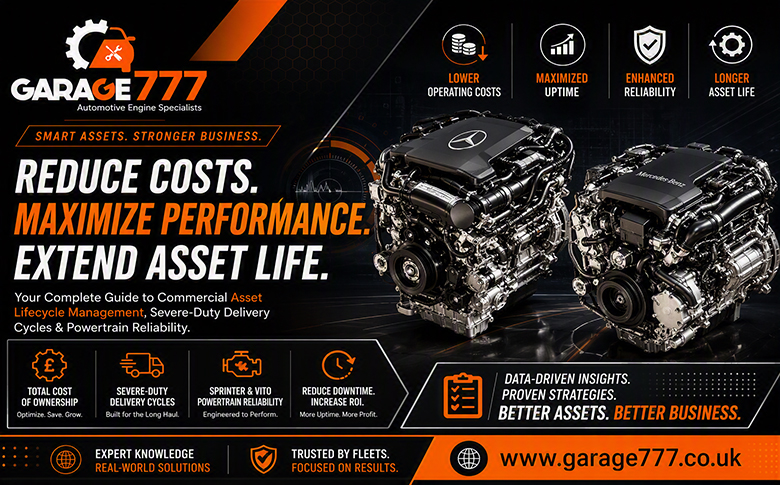
Commercial Asset Lifecycle Management: Total Cost of Ownership, Severe-Duty Delivery Cycles, and Mercedes-Benz Sprinter and Vito Powertrain Reliability
August 3, 2026
The Fleet Pack: Minimizing Repair Bay Downtime, Managing Oil Dilution and Replacing High-Mileage Power Units for Maximum Asset Value
Executive Summary
For commercial logistics managers, transport directors, and high-mileage van operators, fleet vehicles are critical business tools. Maximizing the return on investment of these commercial assets requires balancing daily vehicle use against rising workshop maintenance costs.
When a hard-working delivery van or service vehicle suffers a severe mechanical failure—such as a snapped timing chain, a broken turbocharger, or a cracked engine casting—the sudden loss of that vehicle creates immediate operational stress. Transport managers are forced to choose between scrapping the fully depreciated vehicle, leasing a costly brand-new asset, or sourcing a replacement engine to get the vehicle back to work quickly.
This high-mileage playbook provides a practical framework for commercial vehicle engine management. We break down the math behind Total Cost of Ownership (TCO), analyze how intense stop-and-start delivery routes affect engine life, review the chemical requirements of modern low-emission lubricants, and provide a clear framework for sourcing reliable used engines or precision-built reconditioned engines to keep your business moving efficiently.
- The Fleet Metric: The true cost of an engine breakdown is not just the mechanical repair bill. It is the cumulative financial impact of missed delivery schedules, driver idle time, and short-term replacement van rentals.
- Asset Strategy: When a commercial engine fails, swapping the damaged block with a fully warrantied replacement engine restores the vehicle to field duty for a fraction of the cost of a new vehicle lease.
Section 1: Total Cost of Ownership — Engine Swaps vs. Van Depreciation
When a commercial van's engine breaks down, buying or leasing new Mercedes-Benz engines in the UK is often an unnecessary drain on a company's capital budget.
+-----------------------------------+-----------------------------------+
| Sourcing an Engine Replacement | Buying / Leasing a New Van |
+-----------------------------------+-----------------------------------+
| Low upfront cost (£2,500 - £4,500)| Severe capital outlay (£30,000+) |
| Restores a fully depreciated van | Suffers immediate 20-30% drop in |
| to active duty instantly | book value upon delivery |
| Retains standard fleet insurance | Increases insurance premiums |
+-----------------------------------+-----------------------------------+
The Commercial Math
Consider a high-utilization commercial delivery van valued at £6,000 that suffers a sudden, catastrophic timing chain failure.
- Main dealer repair quotes often exceed the entire value of the van, causing business owners to assume the vehicle is a total loss.
- However, by sourcing a premium reconditioned engine from an independent specialist builder, a fleet manager can purchase a fully rebuilt block for a fraction of that cost.
- Combined with local garage installation, the van is fully restored to working order quickly. This extends the vehicle's working life by another 100,000 miles while avoiding new vehicle depreciation.
Section 2: Severe-Duty Delivery Cycles & The Lubrication Strategy
Commercial vans driven hundreds of miles a day on stop-and-start delivery routes operate under severe-duty cycles that accelerate component wear far faster than standard motorway driving.
[Severe-Duty Stop-and-Start Delivery]
│
┌────────────────────────┴────────────────────────┐
▼ ▼
[Intense Idling Loads] [Emissions System Stress]
Low oil pump pressure at low idle Frequent DPF regenerations cause unburnt
speeds starves top-end valvetrains. fuel to dilute the engine oil sump.
│ │
└────────────────────────┬────────────────────────┘
▼
[Premature Bearing Failure]
1. The Danger of Low-Speed Idling
Delivery vans spend hours idling outside warehouses or in heavy city traffic. During prolonged idling, the engine's oil pump spins at its lowest speed, lowering internal oil pressure. This reduces oil flow to the top-end valvetrain, accelerating wear on camshafts and timing links across high-utilization Mercedes-Benz Sprinter engines and Vito engines.
2. Fuel Dilution & Modern Emissions Traps
Modern commercial diesel engines are equipped with complex emissions systems like Diesel Particulate Filters (DPFs). On short delivery routes, the engine often cannot stay hot enough to complete its automated self-cleaning cycle.
- To force cleaning, the engine control unit injects extra diesel into the cylinders.
- If the journey is cut short, this unburnt fuel washes down the cylinder walls and mixes directly with the engine oil in the sump.
- Over time, this diesel dilutes the engine oil, stripping away its lubricating qualities and causing premature bearing wear on high-mileage blocks like the OM651 diesel (early years) or the OM640 diesel.
Section 3: Evaluating High-Mileage Replacement Alternatives
When choosing a replacement power unit for a commercial vehicle, fleet buyers must match the engine choice to the remaining planned lifespan of the chassis:
- The Fleet-Grade Rebuild (Updated OM651): If a commercial vehicle is under five years old and expected to remain in service for several years, installing a fully reconditioned engine based on the revised OM651 diesel (updated) layout is the most reliable option, as it resolves early injector and timing issues.
- The Compact Delivery Spec (Updated M270/M274): For light urban delivery fleets using smaller vans or cars, sourcing updated versions of the petrol M270 / M274 (updated) engine resolves early timing flaws and ensures excellent operational reliability across the best Mercedes-Benz A-Class engines, B-Class engines, CLA engines, and GLA-Class engines.
- The Value Option: For an older vehicle nearing its planned retirement age, sourcing a verified, low-mileage used engine from a reputable salvage supplier provides a cost-effective solution to keep the vehicle running through its final service window.
Section 4: The Commercial Fleet Sourcing Protocol
To maximize fleet uptime and protect your budget when replacing a commercial vehicle engine, follow this operational framework:
- Enforce Strict Lubricant Standards: Always service your vehicles using approved high-quality Mercedes-Benz engine oil UK to protect internal timing tensioners and minimize the risks of oil breakdown.
- Verify the Timing Component History: Before installing any replacement engine, inspect the timing chain and guides for signs of wear or stretch to prevent future failures.
- Get a Quote: To keep maintenance costs transparent, always seek comprehensive estimates from trade networks to compare the price and warranty coverage of a certified used engine against a fully overhauled reconditioned engine before starting the swap.
Frequently Asked Questions (FAQs)
1. What is the most reliable Mercedes-Benz engine ever made?
The M113 V8 is widely regarded as the most reliable engine, known for exceptional longevity and minimal failures.
2. Which Mercedes-Benz engines should I avoid when buying used?
Avoid early M272 and M273 engines due to balance shaft issues, and early OM651 and OM642 diesels due to injector and swirl flap problems.
3. Are Mercedes-Benz diesel engines reliable in the UK?
Yes, engines like the OM617, OM606, and OM648 are known for exceptional durability and handle UK driving conditions well.
4. What Mercedes-Benz engine lasts the longest?
The OM617 diesel is famous for reaching over 500,000 miles, and many survive over a million miles with proper maintenance.
5. Which Mercedes-Benz engine is best for motorway driving?
The OM648 diesel and M256 inline-six are both excellent for long-distance cruising thanks to strong torque and fuel efficiency.
6. Are reconditioned Mercedes-Benz engines worth buying?
A high-quality reconditioned engine from a trusted supplier is a smart choice and can be more reliable than a high-mileage used engine.
7. What oil should I use for Mercedes-Benz engines in the UK?
Use approved Mercedes-Benz engine oil UK, typically 5W-30 or 5W-40, depending on the engine and climate. Always follow the handbook.
8. Do Mercedes-Benz timing chains last a long time?
Some engines have lifetime chains, but others like early M274, M276, and M271 require earlier inspection or replacement.
9. Which Mercedes-Benz engine is best for towing?
The OM642 diesel and M256 inline-six are excellent towing engines with plenty of torque.
10. Where can I get a replacement Mercedes-Benz engine in the UK?
You can check availability with nationwide trade suppliers who provide certified used engines, reconditioned engines, and low-mileage imports for models across the entire range, from G-Class engines to C-Class vans.
Written by Jennifer James | Dedicated ET Automotive Writer & MechanicCategories
- Audi Engines
- Range Rover Engines
- Volkswagen Engines
- Ford Engines
- BMW Engines
- Subaru Engines
- Honda Engines
- hybrid Engines
- Euro NCAP
- Off-Road Engines
- MINI Engines
- Mitsubishi Engines
- saloon Engines
- Jaguar Engines
- Van Engines
- Land Rover Engines
- Mercedes-Benz Engines
- Nissan Qashqai Engines
- Peugeot Engines
- Skoda Engines
- Vauxhall Engines
- Automatic Transmission
- Alfa Romeo Engines
- Fuel Economy Engines
- Citroen Engines
- Iveco Engines
- SUV Engines
- diesel engines
- Mazda Engines
- cars Engines
- Renault Engines
- engines
- Toyota Engines
- Nissan Engines
- KIA Engines
- Diesel Engine
- Hyundai Engines
- Infographic
- Petrol Engine
- Engine
- UK Engines
- Suzuki Engines
- Daihatsu Engines
- General Engines
- Hatchback
- new technology
- Insurance
- Fiat Engines