Mercedes S-Class W223 Commercial Fleet Asset Management: Balancing Labour Costs, Mileage Depreciation and Engine Replacement Expenses
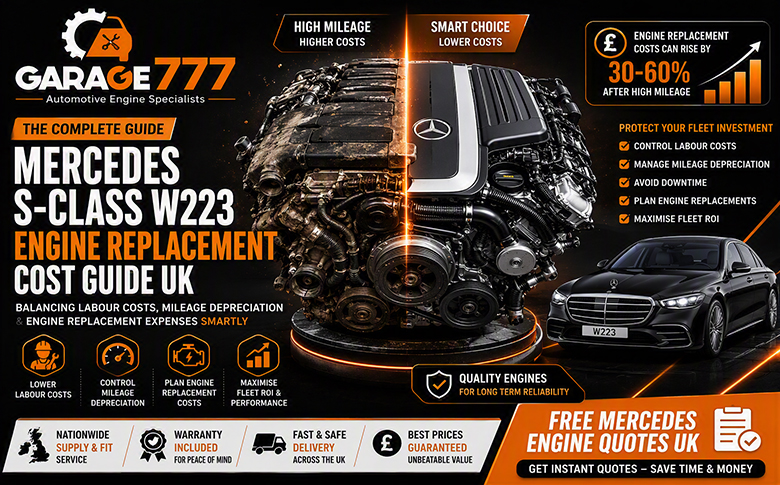
August 5, 2026
Executive Summary
For commercial transport managers, executive chauffeur fleet operators, and high-utilization corporate drivers, luxury saloons represent critical business assets. Maximizing the financial return on investment for these vehicles requires a careful balance between daily road utilization and rising workshop maintenance overheads.
When a heavily driven executive vehicle suffers a sudden powertrain breakdown—such as severe coolant contamination, electrical shorting, or head gasket warping—the loss of that asset creates immediate operational disruption. Fleet managers are forced to choose between selling the non-running asset at a heavy loss, leasing an expensive brand-new replacement, or executing a complete engine swap to get the vehicle back into service quickly.
This high-mileage playbook provides a practical framework for commercial vehicle asset management. We break down the math behind total Cost of Ownership, analyze how severe driving cycles affect engine lifespan, review the impact of regional labour costs, and provide a clear protocol for sourcing a high-quality used engine or a precision-built reconditioned Mercedes S-Class engines, used Mercedes C-Class engines, and rebuilt Mercedes R-Class engines to keep your business moving efficiently.
- The Fleet Metric: The true cost of an engine breakdown is not just the mechanical repair bill. It is the cumulative financial impact of vehicle downtime, driver idle time, and temporary rental fees.
- The Asset Strategy: When a commercial asset fails, executing a targeted engine sourcing strategy to find a fully verified replacement Mercedes engine restores the vehicle to active duty for a fraction of the cost of a new vehicle lease.
Section 1: Total Cost of Ownership — Engine Swaps vs. Fleet Depreciation
When a high-utilization luxury saloon suffers a mechanical failure, purchasing or leasing a brand-new vehicle can create an unnecessary drain on a company's capital budget.
+-----------------------------------+-----------------------------------+
| Sourcing a Mercedes Engine Swap | Buying / Leasing a New Vehicle |
+-----------------------------------+-----------------------------------+
| Low upfront cost (£5,000 - £12,000)| Severe capital outlay (£80,000+) |
| Restores a fully depreciated asset| Suffers immediate 20-30% drop in |
| to active duty instantly | book value upon delivery |
| Retains standard fleet insurance | Increases insurance premiums |
+-----------------------------------+-----------------------------------+
The Commercial Math
Consider a high-utilization executive vehicle that suffers a sudden, catastrophic M256 powertrain failure.
- Main dealer repair quotes routinely range from £22,000 to £28,000+, causing business owners to assume the asset is a total loss.
- However, by sourcing a premium reconditioned engine from an independent specialist, a fleet manager can purchase a fully rebuilt block for £8,000 to £12,000 fitted.
- Combined with independent garage installation, the vehicle is fully restored to working order, extending its working life by another 80,000 to 100,000 miles while completely avoiding new asset depreciation.
Section 2: Severe-Duty Delivery Cycles & The Cooling Strategy
Executive saloons driven thousands of miles a month on high-load routes or severe stop-and-start urban conditions operate under conditions that accelerate component wear far faster than standard driving.
[Severe-Duty Commercial Operation]
│
┌────────────────────────┴────────────────────────┐
▼ ▼
[Intense Idling & Urban Driving] [Thermal Cycling Stress]
High engine bay temperatures accelerate Unaddressed factory seal degradation
degradation of cooling system seals. causes rapid coolant leakage.
│ │
└────────────────────────┬────────────────────────┘
▼
[Premature Component Failure]
1. The Danger of Prolonged Urban Idling
High-utilization fleet vehicles spend significant time idling in city traffic. During prolonged idling, engine bay heat builds up rapidly, placing intense thermal strain on cooling system seals and 48V electrical harnesses.
2. Managing Recall Vulnerabilities (RB-67-2022/23)
Across high-mileage fleets operating M256 engines, unaddressed factory recall defects can lead to sudden coolant loss.
- Escaping coolant runs along engine rails, contaminating nearby 48V wiring looms and sensors.
- This results in sudden electrical short circuits or severe cylinder head warping from localized overheating.
- For long-term fleet reliability, installing a reconditioned engine with upgraded, heat-resistant cooling seals restores total fleet reliability.
Section 3: Evaluating High-Mileage Replacement Alternatives
When choosing a replacement power unit for a fleet vehicle, commercial buyers must match the engine choice to the remaining planned lifespan of the vehicle chassis:
- The Premium Fleet-Grade Rebuild (3.0L M256 Inline-Six): Featured across Mercedes S-Class engines and related platforms, this engine offers outstanding performance when properly sealed. Installing a fully reconditioned unit ensures long-term operational peace of mind.
- The Cost-Effective Salvage Route: For long-serving fleet vehicles with higher chassis mileage, sourcing a verified low-mileage used engine (£5,000 to £8,000) from an accident-free donor provides an extremely cost-effective turnaround option.
- Managing Workshop Labour Costs: Total installation expenses depend heavily on the repair facility chosen. Independent automotive specialists offer reasonable hourly rates and complete swaps in 3 to 5 days, whereas main dealer networks charge high retail fees that push final invoices to £22,000–£28,000.
Section 4: The Commercial Fleet Sourcing Protocol
To maximize fleet uptime and minimize your overall Mercedes S-Class W223 engine replacement cost thresholds, follow this operational framework:
- Enforce Strict Verification Standards: Before buying a used core, always utilize the official GOV.UK vehicle recall checker to cross-reference and verify historical donor vehicle safety records and recall completion status.
- Mandatory Auxiliary Replacements: Always replace all high-pressure coolant seals, fresh thermostats, and structural engine mounts during installation to protect the replacement block against thermal failures or harmful vibrations.
- Manage Electronic Integration: Factor in secondary expenses such as ECU coding, 48V module synchronization, and sensor recalibration, which are mandatory for modern mild-hybrid engine swaps.
- Get a Quote from Verified Networks: To keep commercial maintenance transparent, always coordinate with verified trade suppliers to compare the price, lead times, and warranty terms of multiple units side by side.
Frequently Asked Questions (FAQs)
1. What is the average Mercedes S-Class W223 engine replacement cost in the UK?
Total replacement costs vary based on engine architecture and sourcing route. Sourcing a quality used engine (£5,000 to £8,000) or reconditioned engine (£8,000 to £12,000) through independent specialists saves thousands compared to main dealer quotes (£22,000 to £28,000).
2. Why should fleet managers avoid buying unverified used engines?
Unverified units present a high risk of unaddressed recall defects (such as degrading factory cooling seals), which can result in rapid fluid leakage and electrical failure after installation.
3. What are the typical workshop labour costs for an engine swap in the UK?
Independent specialists offer significantly lower hourly rates compared to main dealers, providing the best financial value for complex executive engine replacements.
4. What mechanical issue causes engine damage in high-mileage M256 engines?
Sub-standard factory cooling seals degrade under heat, letting coolant escape into 48V mild-hybrid electronics and causing rapid overheating that warps the cylinder head.
5. How long does a professional workshop require to complete an engine replacement?
A professional mechanic typically requires 3 to 5 business days of workshop labor to complete a full luxury saloon engine replacement, electrical wiring check, and module recalibration.
6. Is it financially practical to replace the engine in an older executive saloon?
Yes, if the chassis is in good structural condition. Sourcing a high-quality replacement block can extend the vehicle's operational lifespan by another 80,000 to 100,000 miles for a fraction of the cost of a new vehicle lease.
7. How can a fleet buyer verify the true recall status of a donor engine?
Operators should use the official online GOV.UK vehicle recall checker to cross-reference and verify historical recall completion and safety logs from the donor vehicle.
8. Why are upgraded heat-resistant seals mandatory during an M256 overhaul?
Installing upgraded cooling seals permanently fixes the factory defect identified in recall RB-67-2022/23, preventing recurring leaks and protecting nearby 48V electronics.
9. Are other Mercedes-Benz models compatible with the M256 engine?
Yes, the 3.0L M256 inline-six engine is shared across several platforms, including select Mercedes C-Class engines and Mercedes R-Class engines variants.
10. Where can a business owner get a quote for a warranty reconditioned block?
Commercial fleet managers should consult trusted nationwide trade platforms to get a quote from fully vetted UK suppliers, allowing them to verify engine matching codes and check warranty terms.
Written by Jennifer James | Dedicated ET Automotive Writer & MechanicCategories
- Audi Engines
- Range Rover Engines
- Volkswagen Engines
- Ford Engines
- BMW Engines
- Subaru Engines
- Honda Engines
- hybrid Engines
- Euro NCAP
- Off-Road Engines
- MINI Engines
- Mitsubishi Engines
- saloon Engines
- Jaguar Engines
- Van Engines
- Land Rover Engines
- Mercedes-Benz Engines
- Nissan Qashqai Engines
- Peugeot Engines
- Skoda Engines
- Vauxhall Engines
- Automatic Transmission
- Alfa Romeo Engines
- Fuel Economy Engines
- Citroen Engines
- Iveco Engines
- SUV Engines
- diesel engines
- Mazda Engines
- cars Engines
- Renault Engines
- engines
- Toyota Engines
- Nissan Engines
- KIA Engines
- Diesel Engine
- Hyundai Engines
- Infographic
- Petrol Engine
- Engine
- UK Engines
- Suzuki Engines
- Daihatsu Engines
- General Engines
- Hatchback
- new technology
- Insurance
- Fiat Engines