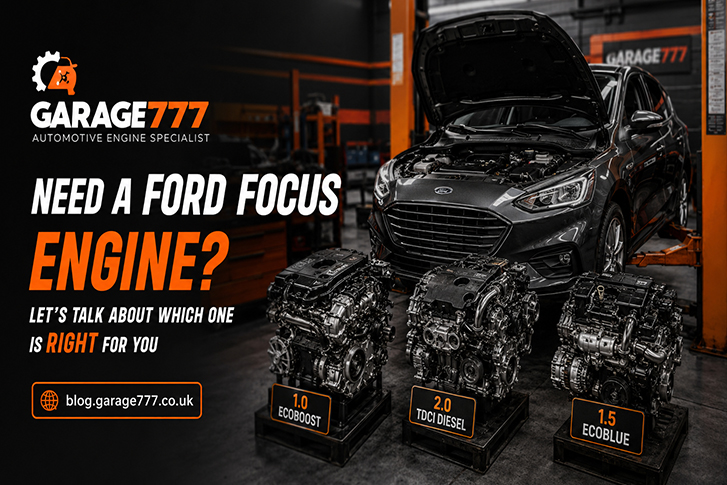
Need a Ford Focus Engine? Let's Talk About Which One Is Right for You
July 24, 2026
Ford Focus Engines Compared: Reliability, Running Costs and Performance
If you are reading this, there's a good chance your Ford Focus has let you down — or you are trying to make sure it doesn't. At Garage 777, we talk to Focus owners every week who are facing the same decision: repair the current engine or replace it entirely. It's a big decision, and we believe you should have all the information before you spend a single penny.
The good news is that the Ford Focus is one of the most common cars on UK roads, which means engines, parts, and knowledgeable mechanics are all readily available. The slightly more complicated news is that there are three very different engines in the Focus range — the 1.0 EcoBoost, the 2.0 TDCi diesel, and the 1.5 EcoBlue — and each one comes with its own set of things you need to know. This guide walks you through all three, in plain English, so you can make the right call for your car and your budget.
Your Ford Focus Engine Options at a Glance
- Our recommendation for high-mileage drivers: 2.0 TDCi Duratorq diesel. Tough engine, timing chain, and the problems it does have are predictable and fixable.
- Our recommendation for local and low-mileage driving: 1.0 EcoBoost, but only post-2019 with proof the timing belt has been done. We see too many pre-2018 EcoBoosts that have been run on the wrong oil.
- The one we suggest being careful with: 1.5 EcoBlue. Lovely engine to drive, but the AdBlue system can cause expensive problems, especially on cars that sit unused for long periods.
- What a replacement typically costs through us: £2,800-£4,500 supplied and fitted, depending on which engine your Focus needs.
- One thing every diesel Focus owner should know: if the DPF has been removed or tampered with, your car will fail its next MOT. No exceptions.
The 1.0 EcoBoost: Brilliant Engineering, but It Needs Looking After
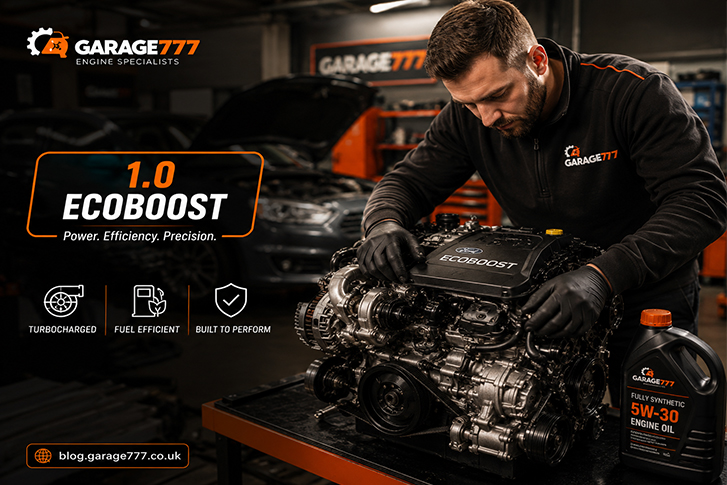
The 1.0-litre EcoBoost is a clever little engine. Three cylinders, a turbocharger, and direct fuel injection all working together to give you the power of a bigger engine with the fuel economy of a much smaller one. Ford sold hundreds of thousands of them, and on the whole, owners are happy with them. But — and this is the important bit — there's a reason we see so many of these engines in our workshop.
The timing belt on the EcoBoost isn't a normal belt. It sits inside the engine, running through the oil, which is why mechanics call it a wet belt. Look, the idea is that oil reduces friction and makes the belt last longer. The problem is that if the wrong oil is used — and we see this all the time, even in cars with full service histories from non-Ford garages — the belt breaks down. Tiny bits of rubber come off and clog the oil pump. The engine starves itself of oil and seizes. Sometimes there's a warning light; often there'sn't.
Our Advice on the EcoBoost
If you are buying a used Ford Focus 1.4 EcoBoost engine, the only thing that truly matters is whether the timing belt has been replaced and whether the oil has been changed every 10,000 miles with the correct Ford oil. We charge around £1,200-£1,800 for a full belt replacement because it involves dropping the sump and checking the oil pump at the same time. It'sn't a quick job, but it's the difference between an engine that gives you another 80,000 miles and one that seizes on the M6 at 70 miles per hour.
There's a second thing we check on every EcoBoost that comes to us: the cooling system. The plastic pipes and housings can crack with age, and a slow coolant leak. that nobody notices eventually causes the engine to overheat and the cylinder head to warp. If you see any white powder or pink crust around the coolant bottle, bring it to us. It's a much cheaper fix before the head gasket goes.
The 2.0 TDCi Diesel: The Engine We Recommend Most Often
We fit more 2.0 TDCi engines at Garage 777 than any other Focus variant, and there's a simple reason: it's the toughest engine Ford put in the Focus. A cast-iron block — heavy, but nearly impossible to crack — and a timing chain instead of a belt mean the engine itself is built to last. We have worked on TDCi engines with 200,000 miles on the clock that are still running perfectly.
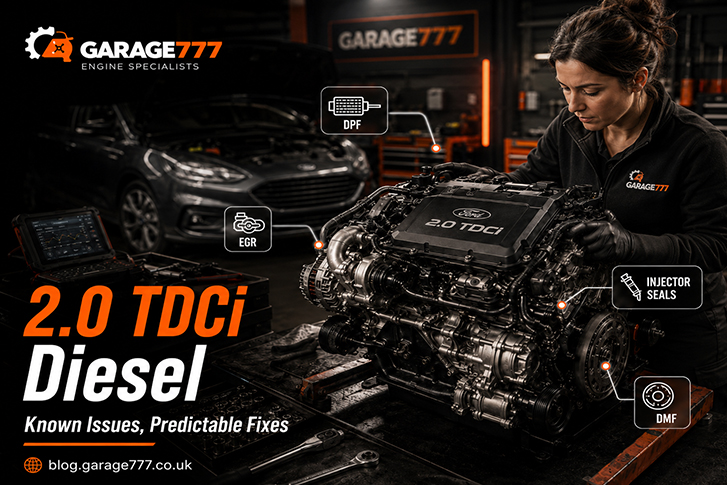
The things that do go wrong are the bits bolted to the engine, not the engine itself: the DPF gets blocked if the car never goes on a motorway, the EGR valve clogs up with carbon, the injector seals start to leak, and the dual mass flywheel wears out at around 100,000 miles. These are all fixable, and they're all predictable. That's what makes the TDCi such a good engine to own — you know what is coming, and you can budget for it.
The Injector Seal Problem (and How We Check It in Five Minutes)
We call it black death — and we don't mean it as a joke. The copper seals at the bottom of each diesel injector wear out over time. Combustion gases leak past them and bake the engine oil into a rock-hard black tar. If you catch it early, we can replace the seals and clean the area for £200-£400. Right, so if you leave it until the injectors are buried in carbon, we need specialist tools to get them. out, and sometimes we've to remove the entire cylinder head — which turns a £300 job into a £1,500 one. Pop into the workshop any time and we will lift the engine cover and check the injectors for you. It takes minutes, and it could save you a fortune.
DPF and EGR: The Two Things That Annoy Diesel Owners Most
The DPF catches the soot that diesels produce and burns it off when the exhaust is hot enough — which means you need to drive the car on a motorway or dual carriageway regularly. If all your driving is around town at 30 miles per hour, the DPF fills up and can't clean itself. We can do a professional DPF clean for £250-£400, but a replacement is £500-£800. Honestly? the EGR valve recirculates exhaust gas and, inevitably, fills up with carbon. A clean costs £150-£300. Neither of these is a reason to avoid the TDCi — every modern diesel has them — but they're costs you need to know about.
The 1.5 EcoBlue: Newer, Smoother, but Needs a Bit More Attention
The 1.5 EcoBlue is the newest diesel in the Focus range, and you can feel it the moment you drive one. It's smooth, quiet, and sips fuel at a rate that makes the TDCi look thirsty. But it brings with it a system that earlier Focus diesels didn't have: AdBlue. This is a fluid that gets injected into the exhaust to reduce harmful emissions, and while it does that job very well, it has a habit of crystallising and blocking its own injector.
[IMAGE: Garage 777 technician running diagnostics on a 1.5 EcoBlue Focus, modern workshop equipment visible]
AdBlue: What You Need to Know
When AdBlue sits in the injector and is exposed to air — which happens every time you switch the engine off — it forms a white crystalline residue. Over weeks and months, this residue builds up and blocks the tiny nozzle that sprays AdBlue into the exhaust. The car knows the system has failed, and it gives you a countdown on the dashboard. When that countdown hits zero, the engine won't start — not because it's broken, but because the computer locks it out.
A replacement AdBlue injector costs £350-£600. A replacement AdBlue pump is £500-£800. These aren't cheap jobs, and they're not optional — you can't just disconnect the system and carry on, because the MOT test will catch it. Our advice with the EcoBlue is to use the car regularly (avoid leaving it parked for weeks), always keep the AdBlue topped up with a fresh bottle rather than letting it run low and crystallise in the tank, and come to us if the countdown warning appears. Early intervention is everything.
What We Charge for a Ford Focus Engine Replacement
At Garage 777, we keep our pricing straightforward. A replacement Ford Focus engine starts from around £1,800 for the unit — that gets you tested, warrantied used engine that we've checked ourselves before ordering. Our labour rate is £75 per hour, and a complete Ford Focus engine swap takes us around 12-15 hours depending on the variant. That brings the total to somewhere between £2,800 and £4,500, including all fluids, gaskets, and a warranty that covers both the engine and our workmanship.
We also offer supply-and-fit reconditioned Ford engines for customers who want peace of mind that every wearing part — bearings, rings, timing components, gaskets — is brand new. These cost more up front but come with a 12-month warranty and are the closest thing to a factory-fresh engine at a price that doesn't involve a main dealer.
Come and Talk to Us About Your Focus
The best engine for your Ford Focus depends on how you use your car. If you are on the motorway every day, the 2.0 TDCi is our top recommendation — it will outlast almost everything else on the road. If you do mostly local journeys, a post-2019 EcoBoost with the belt done is a great daily driver, but please give us the service history to check before you buy the car. The 1.5 EcoBlue is lovely to drive but ask us to run a diagnostic before committing — we can check whether the AdBlue system is healthy in about 20 minutes.
Whatever you decide, the most important thing is to make sure the engine code matches your car. We see people every month who have bought an engine privately, only to find it doesn't fit because the code on the engine doesn't match the one on the V5C. Do not let that be you. Give us a call, bring the car down, and we will help you work out exactly what you need — and find the right engine at a fair price.
Frequently Asked Questions
How do I know if my Focus engine can be repaired or needs replacing?
Bring it to us for a compression test. It takes about an hour, costs £55, and tells us everything we need to know about the internal condition of your engine. We will give you an honest answer — if it's repairable, we will tell you. If replacement makes more financial sense, we will explain exactly why.
Do you supply and fit the engine, or do I have to source it myself?
We do both. If you already have an engine, we will check it over and fit it. If you don't, we will source one from a supplier we trust, at a price we agree with you in advance. No surprises.
How long will my car be off the road for an engine replacement?
Normally three to five working days. We order the engine, it arrives within a couple of days, and fitting takes two days. We will call you when the car is ready for collection.
What warranty do you offer on engine replacements?
All our engine replacements come with a minimum 6-month warranty covering both the engine unit and our labour. If anything goes wrong in that period, bring it back and we sort it — no arguments, no passing the blame to a distant supplier.
Can you service my Focus to prevent engine problems in the first place?
Absolutely. Regular servicing — oil changes every 10,000 miles using the correct specification oil — is the single best thing you can do to extend the life of any Focus engine. We keep full service records so when you come to sell, the next owner can see the car has been looked after properly.
Do you deal with DVLA paperwork after an engine swap?
We will provide you with all the documentation you need — the engine number, the supplier's invoice, and our fitting invoice. You send these to the DVLA with your V5C to update the engine number. It's a straightforward process and we will talk you through it.
I am looking at a used Focus to buy — can you check the engine for me first?
Yes. Bring the car to us for a pre-purchase inspection. We check compression, scan for fault codes, inspect the timing belt or chain, look for oil leaks, and give you an honest report so you know exactly what you are buying. It's £75 and could save you thousands on a car with a hidden problem.
Your Ford Focus deserves an honest mechanic and a fair price. At Garage 777, we will help you find the right engine, fit it properly, and stand behind our work. Give us a call on [phone] or drop into the workshop — we're always happy to have a look and give you our honest advice, no obligation.
Written by Jennifer James | Dedicated ET Automotive Writer & MechanicCategories
- Audi Engines
- Range Rover Engines
- Volkswagen Engines
- Ford Engines
- BMW Engines
- Subaru Engines
- Honda Engines
- hybrid Engines
- Euro NCAP
- Off-Road Engines
- MINI Engines
- Mitsubishi Engines
- saloon Engines
- Jaguar Engines
- Van Engines
- Land Rover Engines
- Mercedes-Benz Engines
- Nissan Qashqai Engines
- Peugeot Engines
- Skoda Engines
- Vauxhall Engines
- Automatic Transmission
- Alfa Romeo Engines
- Fuel Economy Engines
- Citroen Engines
- Iveco Engines
- SUV Engines
- diesel engines
- Mazda Engines
- cars Engines
- Renault Engines
- engines
- Toyota Engines
- Nissan Engines
- KIA Engines
- Diesel Engine
- Hyundai Engines
- Infographic
- Petrol Engine
- Engine
- UK Engines
- Suzuki Engines
- Daihatsu Engines
- General Engines
- Hatchback
- new technology
- Insurance
- Fiat Engines