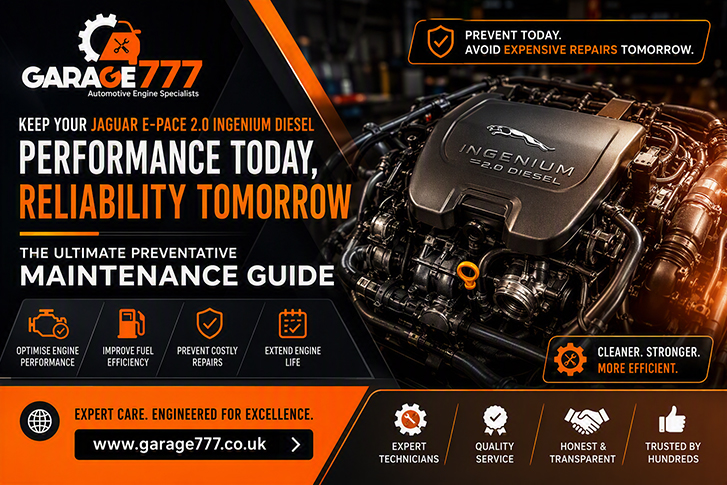
Protecting Your Jaguar E-Pace 2.0 Ingenium Diesel: A Preventative Maintenance Guide
August 17, 2026
Most of the expensive problems associated with the 2.0-litre Ingenium diesel don’t appear overnight. Timing chain wear, EGR cooler cracking and oil dilution are all things that tend to build up gradually — which means there’s a real opportunity for owners to slow them down, or catch them early, with the right habits and servicing routine.
This guide focuses on what you can actually do, rather than just what can go wrong.
Use the Correct Oil, and Don’t Stretch the Interval
The Ingenium diesel is specified for a particular low-SAPS oil grade, and it matters more than it might seem. Low-SAPS (Sulphated Ash, Phosphorus and Sulphur) oils are designed to protect the diesel particulate filter from being clogged by ash deposits, while still providing the film strength the engine needs.
If your Jaguar engine is mostly used for short, stop-start trips — the school run, local errands, short commutes — consider having the oil changed more frequently than the standard interval. Short journeys are exactly the conditions that lead to oil dilution from incomplete DPF regeneration, so slightly shorter oil-change intervals can meaningfully reduce long-term wear on the timing chain, camshaft and turbo.
Give the DPF a Proper Chance to Regenerate
A diesel particulate filter needs sustained engine load and temperature to burn off trapped soot. If every journey is short and slow, the regeneration cycle keeps getting interrupted, and unburnt fuel ends up diluting the oil instead of being burnt off cleanly.
A simple habit helps here: if your driving is mostly urban, try to include a longer run — ideally 20 to 30 minutes at a steady motorway or dual-carriageway speed — every week or two. This gives the DPF the sustained heat it needs and reduces the chances of oil dilution building up unnoticed.
Don’t Dismiss a Cold-Start Noise
It’s tempting to assume a bit of diesel clatter on a cold morning is just how the engine sounds. Get to know what’s normal for your car specifically. If a new metallic rattle appears — particularly one that fades as the engine warms — treat it as worth investigating rather than ignoring. Catching timing chain or tensioner wear early is far cheaper than dealing with the aftermath of a chain that’s jumped or snapped.
Keep an Eye on Coolant Level — Without Assuming It’s a Leak
Check your coolant level periodically, even between services. If it’s dropping and you can’t find an external leak, don’t assume it’s evaporation. On the Ingenium diesel, this pattern can point to an EGR cooler letting coolant into the exhaust or intake system internally. Catching this early, before it causes overheating or emissions faults, is usually a far smaller job than dealing with the consequences.
Keep Your Paperwork
It sounds unglamorous, but keeping invoices, diagnostic printouts and warranty documents in one place pays off. If a fault does appear, a documented service history makes it far easier to establish whether a repair should be covered under warranty, and it protects the car’s resale value if you come to sell it.
Know Where to Check for Recalls and Vehicle History
Before buying a used engine, or before assuming a fault is “just wear and tear”, it’s worth using the official GOV.UK recall checker and the GOV.UK MOT history service to see whether there are any outstanding safety recalls or a pattern of past failures recorded against the vehicle.
Servicing Habits That Make a Real Difference
Beyond the oil grade and interval, a handful of servicing habits tend to separate E-Pace diesels that reach high mileage comfortably from those that develop expensive problems early.
Ask your garage to check, not just top up. When coolant or oil levels are topped up without investigating why they’d dropped, an early-stage fault can go unnoticed for months. Ask specifically whether levels were normal or a top-up was needed, and why.
Have fault codes read periodically, not just when a warning light appears. Issues around EGR flow or DPF regeneration efficiency can register as stored codes before triggering a dashboard warning, so a periodic check can catch problems earlier.
Don’t ignore a warning light because the car still drives normally. It’s tempting to assume that if the car feels fine, a warning light can wait until the next scheduled service. On this engine, several of the more serious faults develop gradually enough that the car can feel largely normal for some time before symptoms become obvious to the driver.
Understanding DPF Regeneration in Practical Terms
It’s worth understanding what’s actually happening during a DPF regeneration cycle, because it explains why driving style matters so much on this engine. As soot builds up in the filter, the engine management system periodically raises exhaust temperatures to burn it off — a process that typically takes a sustained period of higher engine load to complete properly.
If a regeneration cycle starts but the car is stopped, or slows to idle, before it finishes, the cycle is interrupted. Fuel injected as part of that process doesn’t get burnt off as intended, and some of it ends up contaminating the engine oil instead. Interrupted regenerations happening repeatedly, journey after journey, is the underlying pattern behind most oil dilution cases on short-journey cars.
This is why a single weekly longer drive can make a genuine difference: it gives the system a reliable opportunity to complete a regeneration cycle properly, rather than leaving it perpetually half-finished.
Cold Weather and Engine Care
UK winters bring their own set of considerations for a diesel like this. Cold starts place more demand on the timing chain and tensioner before oil pressure fully builds, which is part of why a cold-start rattle is worth taking seriously rather than assuming it’s simply “cold engine noise”. Allowing a brief moment for oil pressure to establish before setting off — rather than pulling away immediately at higher revs — is a small habit that reduces strain during exactly the period when wear on chain components tends to be highest.
Cold weather can also make coolant loss more noticeable, since a marginal EGR cooler fault may show symptoms more readily when the system is working harder to bring the engine up to temperature. If the heater takes longer than usual to produce warm air, or the temperature gauge behaves inconsistently in cold weather, it’s worth having the cooling system checked.
Choosing a Garage That Understands This Engine Family
Not every general garage is equally familiar with the specific quirks of the Ingenium diesel. It’s worth asking directly whether they have experience with this engine family, whether they have tools to check DPF regeneration history and EGR performance, and whether they’re comfortable performing a borescope inspection if a timing chain concern arises.
A Simple Preventative Checklist
- Use the correct low-SAPS oil and consider shortening the interval if most journeys are short
- Take a longer, steady-speed drive every week or two to support DPF regeneration
- Investigate any new cold-start rattle rather than waiting for it to worsen
- Check coolant level periodically, not just when a warning light appears
- Keep service and repair records together
- Check official recall and MOT history services rather than relying on guesswork
Frequently Asked Questions
Does driving style really affect Ingenium diesel reliability?
Yes, meaningfully. Engines built primarily for short urban journeys are more prone to DPF and oil dilution issues than the same engine used mainly on longer runs, simply because of how diesel particulate filters need to regenerate.
How often should I change the oil if I mostly do short journeys?
There’s no single number that suits every car, but it’s worth discussing a shorter-than-standard interval with your garage if short trips make up most of your mileage — ask them to check the oil condition at each service rather than relying on time or mileage alone.
Is a cold-start rattle always a timing chain problem?
Not necessarily, but it’s one of the more common causes on this engine and one of the more serious ones to miss. A quick inspection is a small cost compared with the risk of ignoring it.
Can preventative maintenance completely avoid these faults?
Not entirely — some failures relate to component design rather than usage. But good habits can meaningfully reduce the risk and, just as importantly, mean problems are caught while they’re still cheap to fix.
Why does a stop-start regeneration cycle cause oil dilution?
When the diesel particulate filter’s regeneration cycle is interrupted before completion, some of the extra fuel injected to raise exhaust temperature doesn’t burn off as intended and instead ends up washing into the engine oil, gradually reducing its lubricating properties.
Does cold weather make timing chain wear worse?
Cold starts place extra demand on the chain and tensioner before oil pressure fully builds, which is part of why a cold-start rattle deserves attention rather than being dismissed as normal winter noise.
How do I find a garage that specialises in this engine?
Ask directly about their experience with the Ingenium diesel family, whether they have tools to review DPF regeneration and EGR data, and whether they can perform a borescope inspection rather than relying purely on mileage-based assumptions.
Written by Jennifer James | Dedicated ET Automotive Writer & MechanicCategories
- Audi Engines
- Range Rover Engines
- Volkswagen Engines
- Ford Engines
- BMW Engines
- Subaru Engines
- Honda Engines
- hybrid Engines
- Euro NCAP
- Off-Road Engines
- MINI Engines
- Mitsubishi Engines
- saloon Engines
- Jaguar Engines
- Van Engines
- Land Rover Engines
- Mercedes-Benz Engines
- Nissan Qashqai Engines
- Peugeot Engines
- Skoda Engines
- Vauxhall Engines
- Automatic Transmission
- Alfa Romeo Engines
- Fuel Economy Engines
- Citroen Engines
- Iveco Engines
- SUV Engines
- diesel engines
- Mazda Engines
- cars Engines
- Renault Engines
- engines
- Toyota Engines
- Nissan Engines
- KIA Engines
- Diesel Engine
- Hyundai Engines
- Infographic
- Petrol Engine
- Engine
- UK Engines
- Suzuki Engines
- Daihatsu Engines
- General Engines
- Hatchback
- new technology
- Insurance
- Fiat Engines