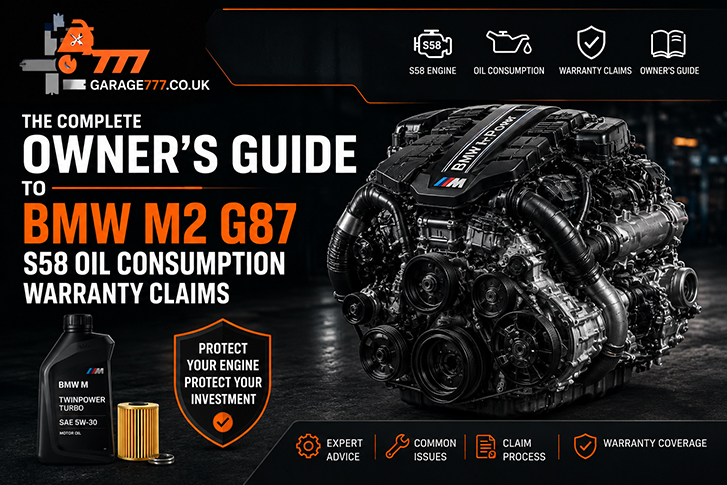
The Complete Owner's Guide to BMW M2 G87 S58 Oil Consumption Warranty Claims
July 15, 2026
Every used BMW engine is backed by BMW's standard 3-year, unlimited-mileage warranty, which is designed to cover genuine manufacturing defects and workmanship errors. Yet many owners of the S58 engine are surprised to learn that an oil consumption warranty claim is never approved automatically just because the car is still within the cover period.
This guide walks through how BMW actually evaluates an oil consumption claim, what evidence strengthens your case, how track driving can complicate an approval, and what your realistic options are if the claim is turned down. It is written for owners who want a clear, evidence-based understanding of the process rather than dealership guesswork.
How BMW Assesses an Oil Consumption Claim
Before BMW authorises any warranty work, the engine must demonstrate oil usage above an accepted tolerance during genuine road driving. The manufacturer also expects proof that BMW-approved oil was used, that the service history is complete, and that consumption was measured using an approved test protocol rather than informal dipstick checks.
Assessors typically look for a pattern of abnormal consumption rather than a single low reading, since a one-off top-up rarely indicates a genuine internal fault.
Warranty Approval Checklist
|
Requirement |
Why It Matters |
Owner Action |
|
Consistent above-limit consumption |
Confirms a repeatable fault, not a one-off event |
Log readings over multiple intervals |
|
Approved oil specification |
Wrong oil can itself cause consumption |
Keep receipts showing correct grade |
|
Complete service history |
Missing services undermine credibility |
Retain every invoice and stamp |
|
Confirmed diagnostic result |
Proves an internal, not external, issue |
Request compression/leak-down testing |
|
No evidence of misuse |
Misuse shifts liability to the owner |
Avoid unexplained gaps in usage records |
What Typically Qualifies for Cover
• Oil consumption that stays consistently above BMW's accepted threshold across repeated checks
• Consumption occurring mainly during normal road use rather than exclusively after circuit driving
• Verified use of Longlife-04 or equivalent approved lubricant
• A servicing record with no missed or overdue intervals
• Diagnostic confirmation such as a compression test, leak-down test, or turbo seal inspection
• No signs of neglect, incorrect oil, or unreported track abuse
Why Track Use Complicates Approval
Taking an M2 G87 onto a circuit does not automatically void cover, but it does raise the bar for evidence. BMW technicians are trained to look for signs of sustained high-RPM operation, launch-control use, or inadequate preparation before a session, and dealers may argue these push wear outside 'normal operating conditions'.
The deciding factor is usually documentation: an owner who can show oil checks, cool-down routines, and correct servicing around every track day is in a far stronger position than one who cannot.
• Missing pre- and post-session oil level checks
• Use of a non-approved lubricant, even temporarily
• Overdue servicing at the time of the fault
• No documented cool-down period after hard laps
• Evidence of prolonged extreme RPM use
• No written record of track-day preparation
Recording Oil Consumption, the Right Way
BMW may require a formal oil consumption test, often run over roughly 1,000 miles with the filler cap and dipstick area sealed so no uncontrolled top-ups can occur. Owners who prepare good records well before this stage tend to have a smoother experience.
The iDrive system's oil-level display is the easiest way to log readings consistently, and pairing this with photographic evidence removes any ambiguity about dates or mileage.
• Date and mileage for every oil-level reading
• Photos or screenshots of iDrive oil data
• Receipts confirming approved oil purchases
• Full service invoices
• Track-day preparation notes
• Independent or dealer diagnostic reports
If the Warranty Claim Is Refused
When BMW declines cover and internal damage is confirmed, UK repair costs for the S58 engine commonly fall between £4,200 and £8,500 or more, depending on parts, labour rate, and the extent of damage such as scored cylinder liners or worn piston rings.
An independent BMW specialist can sometimes offer a second diagnostic opinion, which is useful both for disputing the original decision and for sourcing a more cost-effective repair path, including a reconditioned engine with its own supplier warranty.
Understanding the Root Causes of S58 Oil Burning
Before pursuing a claim, it helps to understand what actually drives excessive oil consumption in the S58 engine. Most cases trace back to one of a small number of mechanical causes, and knowing which applies to your car can shape the conversation with a dealer or specialist.
Piston ring wear or improper seating is one of the most frequently cited causes, allowing oil to migrate past the rings and burn in the combustion chamber. Turbocharger seal degradation is another common contributor, particularly in cars subjected to sustained high boost pressure without adequate cooling periods. Less commonly, scored cylinder liners develop from a combination of thermal stress and inadequate lubrication, often compounding the original fault over time.
Common Root Causes at a Glance
|
Suspected Cause |
Typical Symptom |
Diagnostic Method |
|
Piston ring wear |
Gradual, consistent oil loss |
Compression and leak-down testing |
|
Turbocharger seal wear |
Blue smoke under load, oil loss spikes |
Turbo inspection, boost leak test |
|
Cylinder liner scoring |
Accelerating consumption over time |
Borescope inspection, compression test |
|
PCV system fault |
Inconsistent readings, pressure build-up |
PCV valve and hose inspection |
Working With a Dealer Versus an Independent Specialist
Owners often assume the only path forward is through the supplying BMW dealer, but that is not strictly true. A main dealer remains the correct first stop for any claim still inside the manufacturer's cover, since only BMW can authorise warranty-funded repairs. However, if the relationship with a particular dealer becomes strained, or the diagnosis feels rushed, a second opinion from an independent BMW specialist is a reasonable and often valuable step.
Specialists familiar with the S58 platform frequently have deeper hands-on experience with this specific engine than a general service department, and their reports can carry real weight if a claim is disputed or escalated to BMW's customer service team.
• Main dealer: required for any warranty-funded repair authorisation
• Specialist: useful for a second diagnostic opinion or dispute support
• Specialist: often faster turnaround for non-warranty diagnostic work
• Dealer: better positioned to escalate directly within BMW's internal process
Building a Long-Term Ownership Strategy
Owners planning to keep an M2 G87 for several years benefit from treating oil consumption monitoring as a routine habit rather than a reactive measure taken only after a problem appears. A simple habit of checking and logging oil levels every few weeks, even outside of any suspected issue, creates a running history that becomes invaluable if a claim is ever needed.
This proactive approach also tends to catch developing problems earlier, when repair costs and the scope of any required work are usually smaller. Many specialists report that early intervention, before oil starvation causes secondary damage, keeps both diagnostic and repair costs considerably lower than waiting until the problem becomes severe.
How Regional Dealers Can Differ in Practice
Although BMW UK sets national policy on warranty cover, owners frequently report that the actual experience of raising an oil consumption claim can vary noticeably between individual dealerships. Some service departments are highly experienced with S58 engine claims and know exactly what evidence to request upfront, while others may be less familiar with the specific patterns associated with this engine family.
This variation is one more reason to arrive prepared rather than relying entirely on the dealer to guide the process. An owner who already has organised oil level logs, complete service invoices, and a clear account of any track use puts the service advisor in a position to move the claim forward quickly, rather than requesting evidence piecemeal over several visits.
• Ask the service advisor directly what test protocol will be used before work begins
• Request a written summary of what evidence has been submitted to BMW
• Keep a personal copy of every document handed to the dealer, not just the originals
• If a claim stalls for weeks without update, request a status check in writing
Setting Realistic Expectations for Timeframes
A full oil consumption warranty claim, including a formal 1,000-mile test, diagnostic work, and BMW's internal review, can reasonably take several weeks from first report to final decision. Owners who understand this timeline in advance tend to find the process considerably less frustrating than those expecting an immediate answer.
Booking the car in as early as a concern is noticed, rather than waiting until consumption becomes severe, generally shortens the overall timeline and reduces the risk of secondary damage developing while the claim is still under review.
Frequently Asked Questions
Is oil consumption automatically covered under BMW warranty?
No. The car must show consumption above an accepted tolerance, and the owner must prove correct oil, complete servicing, and a valid test result before BMW will authorise work.
Does driving on track void the warranty?
Not automatically, but it makes the claim harder to prove. Clear preparation and maintenance records are essential if the car has seen circuit use.
What does a BMW oil consumption test involve?
Typically, a monitored period of around 1,000 miles, sometimes with the filler area sealed, to measure genuine usage without uncontrolled top-ups.
What if the dealer rejects my claim?
An independent BMW specialist inspection can provide a second opinion and supporting evidence for a formal dispute.
What usually causes S58 oil burning in the first place?
Piston ring wear, turbocharger seal degradation, and in more advanced cases cylinder liner scoring are the most commonly identified causes.
Should I go straight to an independent specialist instead of the dealer?
Not for an active warranty claim, since only the dealer network can authorise warranty-funded repairs, but a specialist is a useful second opinion if a claim is disputed.
Written by Jennifer James | Dedicated ET Automotive Writer & MechanicCategories
- Audi Engines
- Range Rover Engines
- Volkswagen Engines
- Ford Engines
- BMW Engines
- Subaru Engines
- Honda Engines
- hybrid Engines
- Euro NCAP
- Off-Road Engines
- MINI Engines
- Mitsubishi Engines
- saloon Engines
- Jaguar Engines
- Van Engines
- Land Rover Engines
- Mercedes-Benz Engines
- Nissan Qashqai Engines
- Peugeot Engines
- Skoda Engines
- Vauxhall Engines
- Automatic Transmission
- Alfa Romeo Engines
- Fuel Economy Engines
- Citroen Engines
- Iveco Engines
- SUV Engines
- diesel engines
- Mazda Engines
- cars Engines
- Renault Engines
- engines
- Toyota Engines
- Nissan Engines
- KIA Engines
- Diesel Engine
- Hyundai Engines
- Infographic
- Petrol Engine
- Engine
- UK Engines
- Suzuki Engines
- Daihatsu Engines
- General Engines
- Hatchback
- new technology
- Insurance
- Fiat Engines