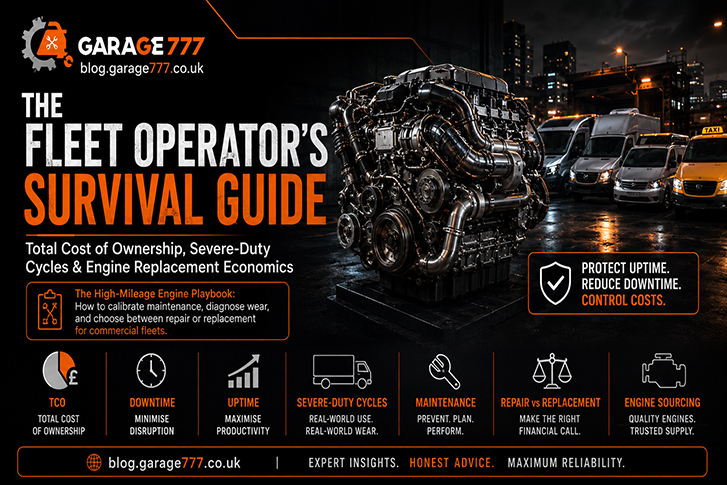
The Fleet Operator’s Survival Guide: Total Cost of Ownership, Severe-Duty Cycles and Engine Replacement Economics
July 22, 2026
The High-Mileage Engine Playbook: How to Calibrate Maintenance, Diagnose Wear, And Choose Between Repair or Replacement for Commercial Fleets
Executive Summary
For commercial fleet managers, logistics operators, and high-mileage drivers, vehicles are not just transport—they are critical business assets. Every minute a delivery van, taxi, or service vehicle spends sitting in a workshop repair bay represents lost revenue, missed deliveries, and rising operational costs.
In the commercial sector, managing vehicle lifespans is a balancing act of numbers. When a vehicle passes the 150,000-mile mark, key internal parts naturally begin to wear down. This leaves fleet operators with a high-stakes decision: Do you continue to pay for expensive repairs on a aging engine, scrap the vehicle and buy a new one, or swap out the power unit with a high-quality replacement?
This comprehensive guide is designed as an operational manual for high-mileage vehicle management. We will look at the math behind Total Cost of Ownership (TCO), analyze how extreme operating conditions affect engine life, explore the chemistry of modern lubricants, and map out how to source a reliable used engine or reconditioned engine through platforms like www.garage777.co.uk to maximize vehicle uptime and protect your bottom line.
- The Fleet Rule: The true cost of an engine failure is not just the mechanic's bill—it is the combined cost of vehicle downtime, driver wages while waiting, and replacement vehicle rentals.
- The Procurement Advantage: Using a verified engine matching portal like Garage777 lets fleet managers compare multiple wholesale quotes instantly, minimizing vehicle downtime and saving thousands on parts.
Section 1: The Replacement Math — Engine Swap vs. Vehicle Replacement
When a commercial engine fails, the immediate reaction of some business owners is to lease or buy a new vehicle. However, looking closely at the depreciation curves and financing costs of commercial vehicles reveals a clear financial alternative.
+-----------------------------------+-----------------------------------+-----------------------------------+
| Financial Metric | Option A: Buy/Lease a New Van | Option B: Install a Recon Engine |
+-----------------------------------+-----------------------------------+-----------------------------------+
| Upfront Capital Outlay | High (£28,000 - £45,000) | Low to Moderate (£2,500 - £5,000) |
| | (or high monthly lease payments) | |
+-----------------------------------+-----------------------------------+-----------------------------------+
| Asset Depreciation Impact | Immediate (loss of 20-30% value | Zero (fully restores value of the |
| | in year one) | existing depreciated asset) |
+-----------------------------------+-----------------------------------+-----------------------------------+
| Insurance Premium Change | Increases (due to higher asset | Static (replaces identical |
| | valuation) | factory-spec unit) |
+-----------------------------------+-----------------------------------+-----------------------------------+
| Vehicle Downtime | Days to weeks (waiting on factory | 2 to 4 working days |
| | spec delivery) | |
+-----------------------------------+-----------------------------------+-----------------------------------+
| Return on Investment (ROI) | Slow (depreciating asset over | Instant (restores business- |
| | 3 to 5 years) | generating asset immediately) |
+-----------------------------------+-----------------------------------+-----------------------------------+
The Economics of the Swap
Consider a standard delivery van (like a Ford Transit or Mercedes-Benz Sprinter) with a market value of £8,000 that suffers a catastrophic timing chain failure.
- A main dealer may quote £10,000 for a new replacement engine, leading many owners to believe the vehicle is a write-off.
- However, by using a specialized network like www.garage777.co.uk, a fleet manager can source a high-quality reconditioned engine for around £2,800.
- After factoring in £1,000 for professional installation, the van is fully restored to working order for £3,800. This extends the vehicle's working life by another 100,000+ miles for a fraction of the cost of a new replacement vehicle.
Section 2: Severe-Duty Cycles — Why Commercial Engines Wear Out Faster
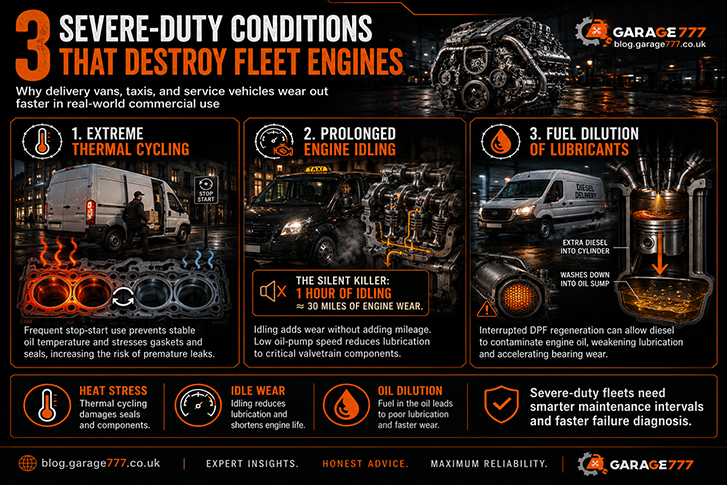
A commercial vehicle that is driven 300 miles a day in stop-and-start city traffic wears out much faster than a passenger car driven the same distance on the motorway. This type of use is classified as a severe-duty cycle.
[Severe-Duty Cycle: Stop-and-Start Delivery]
│
┌─────────────────────────┴─────────────────────────┐
▼ ▼
[Thermal Spikes] [Extreme Idling]
(Constant stopping prevents (Low oil flow under load
steady cooling; oil degrades) accelerates bearing wear)
1. Extreme Thermal Cycling
Delivery vehicles are subjected to constant stop-and-start cycles. The engine is repeatedly turned off to make deliveries and restarted minutes later. This prevents the oil from maintaining a stable operating temperature and subjects internal gaskets and seals to rapid heating and cooling, which can cause premature leaks.
2. Prolonged Engine Idling
Service vehicles, utility trucks, and taxis spend hours idling to run heaters, air conditioning, or onboard tools.
- The Silent Killer: Engine idling does not register on the vehicle's odometer, but it still subjects the engine to wear. One hour of idling is roughly equivalent to 30 miles of normal driving wear.
- During idling, the engine's oil pump spins at its lowest speed, reducing oil flow to critical top-end valvetrain parts and accelerating wear on camshaft lobes and rocker arms.
3. Fuel Dilution of Lubricants
In diesel delivery vans fitted with Diesel Particulate Filters (DPFs), short city journeys can prevent the DPF from completing its self-cleaning (regeneration) cycle. To force regeneration, the engine control unit (ECU) injects extra diesel into the cylinders.
- If the drive is cut short, this unburnt diesel can wash down the cylinder walls and mix directly with the engine oil in the sump.
- Over time, this diesel dilutes the engine oil, stripping away its lubricating qualities and causing rapid wear on the main crankshaft and connecting rod bearings.
Section 3: Lubricant Chemistry — Protecting Your Replacement Engine
When managing a high-mileage fleet, using cheap engine oil to save on maintenance costs is a costly mistake. Modern engine lubricants are highly complex chemical fluids designed to protect metals under extreme pressures.
The Advantages of Full Synthetic Oils
Unlike mineral oils, which are refined directly from crude oil, synthetic lubricants are chemically engineered from pure base molecules.
- Uniform Molecule Size: Synthetic molecules are identical in size and structure, which significantly reduces internal friction and drag. This can improve fuel economy by up to 2%.
- High Shear Stability: Under intense pressure (such as inside a turbocharger bearing running at 150,000 RPM), mineral oil molecules can shear and break apart, losing their lubricating properties. Synthetic oils resist this breakdown, maintaining a protective film of oil between moving parts.
- Excellent Low-Temperature Flow: Synthetic oil flows quickly even at sub-zero temperatures. This ensures that when an engine is started on a cold morning, oil reaches the cylinder heads and camshafts in milliseconds, reducing start-up wear.
Deciphering Oil Additives
Modern engine oil contains a carefully balanced package of chemical additives:
- Detergents & Dispersants: These catch carbon soot and hold it in suspension within the oil, preventing it from forming thick sludge on the oil pickup tube or inside oil passages.
- Anti-Wear Agents (e.g., ZDDP): These form a microscopic sacrificial barrier on high-pressure metal-on-metal wear points, such as camshaft lobes and lifters.
- Viscosity Index Improvers: These polymer chains expand as the oil heats up, helping the oil maintain its thickness (viscosity) at high temperatures while remaining fluid when cold.
Section 4: Used vs. Reconditioned Engines for Fleet Operations
When sourcing replacement engines for commercial vehicles, fleet managers must balance the upfront purchase price against the expected remaining service life of the vehicle.
+-----------------------------------+-----------------------------------+-----------------------------------+
| Fleet Planning Metric | Used Engine Replacement | Reconditioned Engine Replacement |
+-----------------------------------+-----------------------------------+-----------------------------------+
| Ideal Vehicle Age | Older vehicles (5+ years old) | Newer premium fleet vans |
| | nearing scheduled retirement | (under 4 years old) with long life|
+-----------------------------------+-----------------------------------+-----------------------------------+
| Expected Remaining Mileage | 30,000 - 50,000 Miles | 100,000+ Miles (zero-mile spec) |
+-----------------------------------+-----------------------------------+-----------------------------------+
| Upfront Part Sourcing Cost | Very Low (£600 - £1,500) | Moderate (£1,800 - £3,500) |
+-----------------------------------+-----------------------------------+-----------------------------------+
| Warranty Backing | 30 to 90 Days (Parts Only) | 12 to 24 Months (Parts & Labor) |
+-----------------------------------+-----------------------------------+-----------------------------------+
| Downtime Prevention Risk | Moderate (risk of secondary issue)| Extremely Low (high reliability) |
+-----------------------------------+-----------------------------------+-----------------------------------+
The Case for the Fleet-Grade Reconditioned Engine
If a delivery van is under four years old and is expected to remain in active service for several years, installing a reconditioned engine is the most reliable option.
- Because these engines are completely rebuilt with brand-new wear parts, they offer the same reliability, fuel efficiency, and emissions profile as a brand-new vehicle.
- They also come with extended parts-and-labor warranties, protecting your business from unexpected repair costs.
The Case for the Budget-Friendly Used Engine
If a vehicle is nearing its planned retirement age (e.g., scheduled to be retired or sold in 12 months), spending several thousand pounds on a reconditioned engine may not yield a positive return on investment.
- Sourcing a verified used engine from a low-mileage donor vehicle is the logical choice here.
- It gets the vehicle back on the road quickly for minimal cost, allowing it to complete its remaining service life before retirement.
Section 5: Preventive Fleet Maintenance Protocols
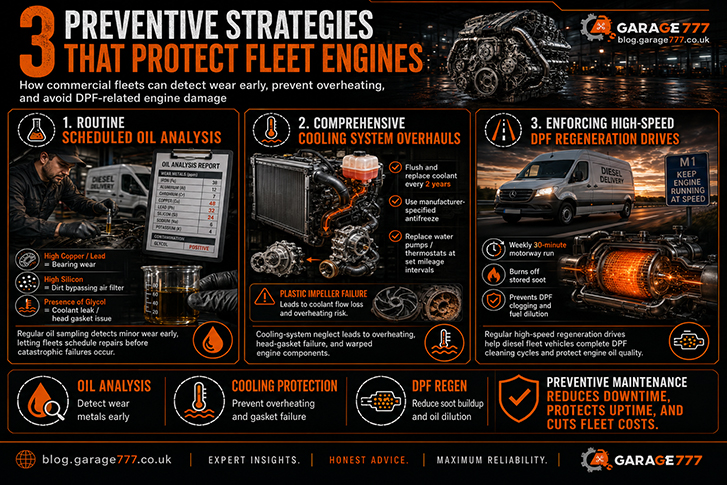
To avoid catastrophic engine failures and keep your replacement engines running reliably, your workshop should follow a strict preventive maintenance protocol.
[OIL ANALYSES] ───► Detects micro-metals (early bearing wear)
│
▼
[COOLING CHECKS] ──► Prevents head warping and gasket failures
│
▼
[DPF REGENERATIONS] ─► Stops fuel dilution of engine sump oil
1. Routine Scheduled Oil Analysis (SOA)
Do not wait for your engine oil to turn black to change it. For critical fleet assets, implement a routine oil analysis program:
- During routine oil changes, take a small sample of the used oil and send it to a specialized laboratory.
- The lab will analyze the oil for microscopic wear metals:
- High Copper/Lead levels: Indicates wear on the crankshaft or connecting rod bearings.
- High Silicon levels: Suggests dirt is bypassing the engine's air filter.
- Presence of Glycol: Points to an internal coolant leak, such as a failing head gasket.
- Detecting these minor issues early allows you to schedule repairs during normal downtime, preventing catastrophic engine failures on the road.
2. Comprehensive Cooling System Overhauls
The leading cause of head gasket failures and warped cylinder blocks is cooling system neglect.
- Flush the engine's cooling system and replace the coolant every two years using the exact manufacturer-specified antifreeze formula.
- Replace plastic water pumps and thermostats at set mileage intervals (e.g., every 80,000 miles). Over time, plastic impellers can degrade and split, leading to sudden overheating under heavy loads.
3. Enforcing High-Speed DPF Regeneration Drives
For fleets operating diesel vehicles on short delivery routes, schedule a weekly "regeneration drive."
- Take the vehicles on a 30-minute motorway run at highway speeds once a week.
- This allows the exhaust system to reach the high temperatures required to safely burn off stored soot, preventing DPF clogging and fuel dilution of the engine oil.
Frequently Asked Questions (FAQs)
1. How does idling affect the life of an engine?
Idling is highly demanding on engines. At idle, the engine runs at low speeds and low oil pressure, which reduces oil flow to the cylinder heads and valvetrain. Idling also leads to incomplete fuel combustion, allowing raw fuel to wash down the cylinder walls and dilute the engine oil in the sump. For commercial fleets, one hour of idling is roughly equivalent to 30 miles of normal road wear.
2. What is fuel dilution, and how can I prevent it?
Fuel dilution occurs when unburnt diesel or petrol slips past the piston rings and mixes with the engine oil in the sump, which reduces the oil's lubricating effectiveness. It is common in diesel vans used for short stop-and-start journeys, where the DPF cannot complete its self-cleaning cycle. To prevent this, ensure your vehicles are driven at motorway speeds regularly to allow the exhaust system to clean itself.
3. Is it possible to swap a commercial diesel engine for a petrol model?
While physically possible because some vans are manufactured with both petrol and diesel options, this type of swap is incredibly complex and expensive. You would need to replace the engine, fuel tanks, fuel lines, the exhaust system, wiring harnesses, and the engine control unit (ECU). It is almost always far cheaper and faster to source an identical, direct-fit replacement diesel engine.
4. How does oil analysis help prevent engine failures?
Oil analysis looks for microscopic wear metals suspended in your used engine oil. By identifying elevated levels of copper, lead, or aluminum, technicians can spot early wear on bearings or pistons before a major failure occurs. This allows you to schedule repairs proactively during planned downtime, avoiding expensive breakdowns on the road.
5. What does the warranty on a reconditioned engine cover?
A premium warranty on a reconditioned engine typically covers both the replacement parts and the labor costs to install them for 12 to 24 months. In contrast, standard used engine warranties from salvage yards are usually parts-only and do not cover workshop labor costs if the replacement engine fails.
6. How can a fleet manager find an exact-match replacement engine quickly?
To minimize vehicle downtime, fleet managers should use a specialized platform like Garage777. By entering the vehicle's registration number, the system instantly matches you with verified UK suppliers stocking the exact engine code and emissions rating your vehicle requires, ensuring a quick and accurate replacement process.
Written by Jennifer James | Dedicated ET Automotive Writer & MechanicCategories
- Audi Engines
- Range Rover Engines
- Volkswagen Engines
- Ford Engines
- BMW Engines
- Subaru Engines
- Honda Engines
- hybrid Engines
- Euro NCAP
- Off-Road Engines
- MINI Engines
- Mitsubishi Engines
- saloon Engines
- Jaguar Engines
- Van Engines
- Land Rover Engines
- Mercedes-Benz Engines
- Nissan Qashqai Engines
- Peugeot Engines
- Skoda Engines
- Vauxhall Engines
- Automatic Transmission
- Alfa Romeo Engines
- Fuel Economy Engines
- Citroen Engines
- Iveco Engines
- SUV Engines
- diesel engines
- Mazda Engines
- cars Engines
- Renault Engines
- engines
- Toyota Engines
- Nissan Engines
- KIA Engines
- Diesel Engine
- Hyundai Engines
- Infographic
- Petrol Engine
- Engine
- UK Engines
- Suzuki Engines
- Daihatsu Engines
- General Engines
- Hatchback
- new technology
- Insurance
- Fiat Engines