A Pressure Wash Doesn’t Fix Worn Bearings: How to Buy a Reconditioned Land Rover Discovery II Engine Without Getting Scammed
June 18, 2026
Exposing the Disguised Engine Blueprint: The 9 Critical Checks for Sourcing a Genuine, Low-Risk Remanufactured or Second-Hand Land Rover Discovery II Engine
You are about to know what the internal sourcing team at an elite vehicle procurement operation checks every single time. Most buyers never get this level of transparency, leaving them entirely exposed to the dark mechanics of salvage yard deception. When your legendary but notoriously sensitive Rover V8 or Td5 unit fails, the pressure to get back on the road makes you prime target for the cosmetic disguise scam.
Why Does a Visual Inspection Tell You Absolutely Nothing About a Reconditioned Land Rover Discovery II Engine's Real Condition?
A spotless engine bay or a pristine, steam-cleaned engine block on a shipping pallet tells you absolutely nothing about the internal physical state of the mechanical components. Rogue traders across the UK regularly use high-pressure washers, wire brushes, and cheap aerosol engine paint to camouflage years of oil sludge, severe overheating damage, and advanced valvetrain wear. What looks like a pristine, ready-to-drop-in unit on an online listing is frequently a mechanically dead core pulled straight from a scrap vehicle that has suffered from decades of poor servicing.
Photographic fraud is rampant across online marketplaces, with vendors reusing the same three high-resolution stock photos of an immaculate, rebuilt block for dozens of completely different, unverified salvage engines. If you buy solely with your eyes, you are highly likely to pay a premium remanufactured Land Rover Discovery II engine price for a scrap-tier unit that will suffer catastrophic oil pressure failure or liner slippage within its first fifty miles. A pretty exterior cannot mask internal metal fatigue, out-of-round cylinders, or worn-out journals.
What Must You Verify Before Paying for Any Rebuilt Land Rover Discovery II Engine - The 9-Point Professional Sourcing Checklist?
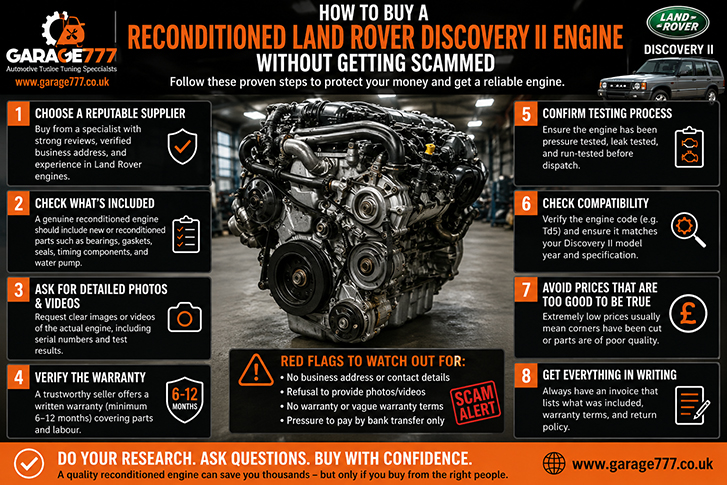
Verifying a supplier's operational legitimacy and engineering transparency is the only definitive method to guarantee you are purchasing a structurally sound powertrain. This comprehensive inspection protocol must be executed step-by-step to expose fraudulent sellers before you part with a single pound.
- Verify the Registered Companies House Address: You must cross-reference the seller’s trading name against the official UK Companies House registry to confirm they are an active legal entity with an established physical workshop. Ignoring this check means you risk buying from a ghost company operating out of a residential property, making legal recourse completely impossible when the component fails.
- Validate the Corporate VAT Number via the HMRC Lookup Tool: You must request the supplier's VAT registration number and verify its status directly on the official UK government portal. If a seller claims to be a high-volume commercial remanufacturer but cannot supply a valid VAT number, they are hiding their true financial footprints and likely bypassing consumer protection laws.
- Secure the Complete Warranty Terms in Writing Pre-Payment: You must obtain the full, unedited warranty policy document via email before transferring any money, rather than relying on vague verbal assurances. The consequence of skipping this is discovering too late that their "12-month warranty" only covers the cost of cheap gaskets while entirely excluding commercial garage labour rates.
- Cross-Reference the Engine Stamping Code Against the V5C Logbook: You must force the supplier to provide clear, high-resolution photographs of the physical engine code and serial number stamped into the alloy block. If this physical number does not match their invoice documentation or alignment history, you will face severe registration and validation issues with the DVLA.
- Demand Verified Cylinder Compression and Leak-Down Test Data: You must insist on seeing documented proof of a compression test across all cylinders, showing uniform pressure margins within factory specifications. Without this data, you risk buying a unit with severely worn piston rings or burnt exhaust valves, resulting in immediate performance loss and blue smoke.
What most independent garages won't tell you is that a genuine remanufacturing outfit will always have a physical commercial cleaning tank and a surface grinding machine visible on their shop floor. If you ask for a quick timestamped photo of their machining area and they send you a picture of an empty garage bay with a couple of hand tools, they are merely outsourcing scrap parts and marking up the used engine price.
How Do You Verify the Correct Reconditioned Land Rover Discovery II Engine Code Before Paying - and Why Getting This Wrong Voids Everything?
Sourcing the exact engine variant for the Discovery II is an absolute engineering necessity because small, subtle differences in production years create insurmountable installation issues. For the 4.0-litre Rover V8 petrol option, you must locate the physical stamping on the deck face of the block, situated between cylinders 3 and 5 on the left-hand side. You are looking for specific prefix codes such as 55D or 56D (for the high-compression variants) or 59D (for low-compression builds), which must match your vehicle’s V5C logbook and VIN profile exactly.
[Vehicle VIN / V5C Logbook] ──► [Engine Block Stamping] ──► [Ancillary Variant Check]
(Must Match) (e.g., 55D / 56D) (Thor Bosch vs GEMS)
Getting this wrong lands you in a devastating warranty black hole. If you mistakenly purchase an older engine block designed for a Range Rover P38 or an early Discovery 1, the physical mounting bosses, crankshaft position sensor spacers, and flywheel indexing setup will not align with your vehicle's factory wiring loom. Even if an incompetent garage manages to force the unit into your engine bay using custom brackets, the engine management system will fail to calibrate, and the supplier will instantly void your warranty because the unit was adapted to an incompatible chassis variant.
What Are the Incompatible Blocks and Hidden Costs Impacting the Remanufactured Engine Price for a Land Rover Discovery II 4.0L?
When calculating the true financial layout of your replacement project, you must look far beyond the initial used engine price quoted on a basic listing. The 4.0-litre Rover V8 block suffers from a well-documented factory design flaw where the aluminium engine block expands at a significantly higher rate than the cast-iron cylinder liners, leading to slipped liners and catastrophic internal coolant leaks. A cheap, standard used engine will almost certainly possess this latent defect, meaning you are simply paying to install another ticking time bomb.
To fix this issue permanently, a genuine rebuilt Land Rover Discovery II engine must be fitted with flanged, "top-hat" cylinder liners which are physically incapable of slipping down the block bores. This precision machining work naturally increases the base remanufactured engine price, but it is the only engineering method that yields a reliable vehicle. Furthermore, you must factor in mandatory ancillary replacement costs; you must never swap over your old oil pump gears, radiator, or oil cooler to a freshly built block, as any trapped metal debris from your previous engine failure will wash straight into the new bearings and destroy them instantly.
Explore More
- 1 Reconditioned Land Rover Freelander Engine Review: Real World Performance & Cost Breakdown
- 2 Second-Hand Land Rover Defender Engine for Sale Near Me: How to Inspect, Verify & Avoid Buying a Bad Engine
- 3 Reconditioned Land Rover Freelander Engines: Real Costs and Hands-On Supply & Fit Experience in the UK
- 4 Second Life for Your Land Rover Range Rover: Used and Reconditioned Land Rover Range Rover Engine
People Also Ask FAQ Engine
What is the average reconditioned engine cost for a Land Rover Discovery II?
A genuine, fully remanufactured 4.0L Rover V8 engine fitted with top-hat cylinder liners typically costs between £3,500 and £5,000 depending on the exact specification. Unverified, basic second-hand units pulled straight from salvage vehicles can be found for lower prices, but they lack critical engineering modifications and carry a very high risk of immediate mechanical failure.
What is the typical used engine price for a Discovery II Td5 diesel?
A standard used Td5 diesel engine from a salvage yard generally costs between £800 and £1,500 based on its verified mileage and overall cosmetic condition. Fully reconditioned Td5 long blocks that have been completely stripped, machined, and rebuilt with new pistons and bearings command a premium price closer to £2,800 to £4,000.
How do I know if a Land Rover Discovery II 4.0L block has a slipped cylinder liner?
A slipped cylinder liner typically manifests as a distinct, rhythmic ticking noise once the engine reaches full operating temperature, often accompanied by pressurised cooling system expansion tanks and mysterious coolant loss. Unlike bad hydraulic lifters, this sound occurs because the cast-iron liner expands loosely against the aluminium block deck, dropping down to strike the top of the rotating crankshaft assembly.
What are the exact deck flatness tolerances for a remanufactured Land Rover 4.0L engine?
The maximum allowable deck warpage across the cylinder block face for the 4.0L Rover V8 is strictly 0.05mm (0.002 inches). Any professional engine remanufacturer must check this using a precision machinist's straightedge and feeler gauges, executing a skimming process if the block surface deviates beyond this tight tolerance window.
Can I fit a 4.6L engine block into a Discovery II that originally had a 4.0L engine?
Yes, a 4.6-litre Rover V8 block will physically bolt into a 4.0-litre Discovery II chassis because the external engine block castings share the identical dimensions and mounting points. However, you must transfer over your original 4.0L engine management flywheel timing markers or update your vehicle's ECU programming to accommodate the longer stroke configuration.
Why do Rover V8 oil pump housings crack, and how is it checked during a rebuild?
The front timing cover houses the gear-driven oil pump, which is highly prone to stress-fracturing over time due to crankshaft harmonic vibrations. A reliable remanufacturer will perform a non-destructive magnetic particle inspection (MPI) or dye penetrant test on the alloy housing to uncover microscopic cracks before reassembling the oiling circuit.
Does the UK Consumer Rights Act 2015 protect me if I buy an engine from a private seller?
No, the Consumer Rights Act 2015 only applies to transactions conducted between an individual consumer and a legally registered commercial trader. If you purchase a used engine from a private individual via an online classified listing, the transaction is governed by basic contract laws where the unit is strictly sold as seen, leaving you with zero legal safety nets if it fails.
Equipping yourself with elite engineering data is the ultimate shield against deceptive trade practices, but the final step is partnering with an established team that treats engine building as a strict science. If you are ready to stop gambling on unverified salvage listings and want to invest in a precision-engineered powertrain built to last a lifetime, navigate directly over to our curated inventory of certified units. Connect with a dedicated Land Rover component specialist today by viewing our verified [Land Rover Discovery II Engine Sourcing Solutions].
Written by Jennifer James | Dedicated ET Automotive Writer & MechanicCategories
- Audi Engines
- Range Rover Engines
- Volkswagen Engines
- Ford Engines
- BMW Engines
- Subaru Engines
- Honda Engines
- hybrid Engines
- Euro NCAP
- Off-Road Engines
- MINI Engines
- Mitsubishi Engines
- saloon Engines
- Jaguar Engines
- Van Engines
- Land Rover Engines
- Mercedes-Benz Engines
- Nissan Qashqai Engines
- Peugeot Engines
- Skoda Engines
- Vauxhall Engines
- Automatic Transmission
- Alfa Romeo Engines
- Fuel Economy Engines
- Citroen Engines
- Iveco Engines
- SUV Engines
- diesel engines
- Mazda Engines
- cars Engines
- Renault Engines
- engines
- Toyota Engines
- Nissan Engines
- KIA Engines
- Diesel Engine
- Hyundai Engines
- Infographic
- Petrol Engine
- Engine
- UK Engines
- Suzuki Engines
- Daihatsu Engines
- General Engines
- Hatchback
- new technology
- Insurance
- Fiat Engines